Showing posts with label drugs. Show all posts

Saturday, April 20, 2013

Drugs storm in a teacup

No comments:

Not so much a storm in a teacup as a hurricane in a thimble, the "’drugs in sport’ enquiry — or at least what we can glean from the hyperbolic media coverage — doesn’t seem to be delivering what was promised at the breathless media conference to announce it.


Richard Cooke writes in The Monthly:


More than two months have passed since the release of the ACC’s report into organised crime and drugs, the ‘darkest day in Australian sport’, a date that now seems to signify little more than the start of a fishing expedition.


and


…the ‘150 players’ from two codes to be interviewed? A number fabricated by an executive ‘under pressure’.


At least publicly, the whole exercise is beginning to look like an opportunity for Stephen Dank to serialise his text message library and the AFL, at least, is sticking closely to its ‘zero-tolerance’ policy of guilt by association rather than by evidence.


It may be that there are some substantive outcomes of the enquiry, but the echoes of the Salem witch trials are becoming louder and louder.

Read More

Thursday, February 07, 2013

Only a little bit of effort

No comments:

The announcement on Tuesday that Essendon Football Club had called in the AFL and the Australian Sports Anti-Doping Authority in relation to supplements administered to some players in 2012 has created a tsunami of speculation. Fair enough. It’s a big issue and the implications are potentially devastating.


Sadly, some of the reporting has barely reached rudimentary. An example is Greg Baum’s story in The Age today.


There’s one crucial part of the story that suggests only the most rudimentary research has been done before writing. Baum writes:

Speculation centres on something called peptide. On ASADA's list, it is banned as a substance, in and out of competition, but permissible as a ''product''.

Last year, says ASADA's register, three Queensland amateur rugby players were caught in possession of, using and/or trafficking peptide, and suspended for two to four years.

There’s a lot in common between this story and the apparently magical special ingredients supposedly found in many women’s cosmetics. Take a simple word from chemistry that few average people would be familiar with, and dress it up as something extraordinary.


There is no “substance” called peptide. A peptide is a short chain of amino acids linked by a particular type of bond — a peptide bond, as it happens. A polypeptide is a long, unbroken chain of peptides. Polypeptides are the building blocks of proteins. Proteins are everywhere in organic chemistry. See http://en.wikipedia.org/wiki/Peptide


AussieRulesBlog found this information in about 45 seconds.


Why is this important? Baum’s clear implication is that Essendon players have been using, perhaps inadvertently, a banned substance. The fact is that eating a steak is taking peptides, because the muscle tissue in the steak is built from proteins — which are made up of peptides.


The second part of Baum’s assertion focuses on the implications of taking a banned substance. “Peptide…” says Baum, “… is on ASADA’s list… [and] …is banned as a substance.” Well, that’s sort of true, but a long way from the full story.


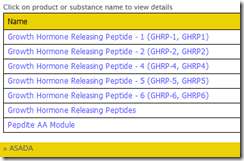
A small number of very specific peptides are on ASADA’s list.
 

asada_peptide 

It’s immediately clear why this issue is big. These banned peptides are responsible for promoting the release of growth hormone which induces the user’s body to create more muscle mass.


Regular readers will know that AussieRulesBlog is a passionate Bombers supporter. We are not defending Essendon, because we don’t know what is happening behind closed doors.


Notwithstanding our own club loyalties, we would expect a senior journalist to have spent the couple of minutes we spent in researching and to be able to inform his readership more effectively than mimicking a cosmetics commercial. It’s a reflection on the quality of the journalism that the story wasn’t written in that way.


As an unfortunate side issue, we were mildly concerned when the Bombers’ 2013 membership collateral began appearing emblazoned with the tagline “Whatever it takes”. We’re betting that someone is wishing they’d knocked back that brazen proposition in favour of something less . . . provocative.


As a Bombers fan, we hope the Bombers are found to be clean. As a football fan, we’re wondering about the trajectory of the game we love. “Whatever it takes” implies an ends justify the means attitude that thumbs its nose at rules and regulations. The Bombers aren’t alone in the mindspace to move heaven and earth to achieve success. In the sport as big business era, success seems to be everything and AussieRulesBlog isn’t sure that’s a good place to be. That must sound rather trite to a Bulldogs or Demons fan.


The spectre of clubs doing less than their utmost in pursuit of a specific goal isn’t new. Priority draft picks almost mandated those actions. Success, or at least a vision of the future that promises a realistic chance of success, seems to be a ‘fix’ that few can deny themselves.


Despite more comfortable stadiums, despite fitter and stronger and more skillful professional players, despite the depredations of the ‘outer’ at suburban football grounds and standing freezing in the rain on the hill, we really miss those days when success was enjoyed, but we were almost as well pleased just to see our boys give a good account of themselves.


Whatever it takes? We’re not sure we want to buy that product.

Read More

Wednesday, October 17, 2012

AFL makes right call on rucks

No comments:

Hooray! It’s not often that AussieRulesBlog is in almost complete sync with the AFL, but we are today.


First and foremost we’ll see an end to the ugly blight of ruck wrestling. Making the rule trialled during the 2012 pre-season a permanent feature, ruckmen will no longer be able to make contact with each other before the ball has left the umpire’s hands.


1_GFHaSy12AW%201764[1]


AussieRulesBlog has a real problem with anyone who thinks the above scene is either attractive or within the other rules of the game. If Mike Pyke and David Hale aren’t holding each other in this image, then AussieRulesBlog should be watching the Melbourne ‘Victory’.


We’re not concerned that inability to wrestle for five minutes before the ball is back into play will somehow advantage ruckmen like Nic Naitanui. For all of a couple of weeks it might, and then the competition’s strategists will figure out a way to limit Naitanui’s effectiveness.


Even supposed ‘dinosaurs’ like Shane Mumford and Darren Jolley will manage. How often have either conceded an easy contest at a centre bounce in the past couple of years? No contact beforehand there, and both Mumford and Jolley have somehow contrived to deliver the ball to their midfielders pretty effectively.


We’re also in the mood to applaud the game’s custodians on their other rule changes, although we’re sad to see the relegation of the umpire’s bounce to a largely ceremonial role. It’s the beginning of the end for the bounce. In five years, it’ll be a curiosity.


Laying on tackled players and pulling the ball in beneath an opponent have been highly unattractive features of the game for too long. We’re not totally convinced about forceful contact beneath the knees, but we acknowledge the danger it poses.


Of course, there’s often quite a distance between our expectations of how a new rule will influence the game and how The Giesch’s mob implement that rule. that will be the test and we’ll reserve absolute applause until we see the rules in action.


Interchange cap
Unfortunately, there’s been a lack of will to implement an interchange cap. Long-time readers will recall that AussieRulesBlog wrote passionately of the benefits of a cap over a substitute. And, largely, our fears have been realised. There’s not that big a difference between rotation numbers in 2012 and what they were before the substitute. Entirely predictable — and we predicted it!


Surprising no-one, Barcodes chief cook and bottle washer, Eddie Everywhere, decided to wheel out the super hyperbole and suggested AFL players will be blood doping within weeks.


We’re not sure what Eddie has been sniffing, but we want some! The facts are that the game has become quicker because of unfettered interchange. Yes, players have become fitter, but their running capacity has been significantly enhanced by having more short rests. Some of Dane Swan’s visits to the pine last only thirty seconds.


It’s only logical that reducing interchanges — which the three-and-one bench was supposed to do and patently failed to achieve — will reduce players’ running capacity. They could dope, and thanks for that helpful suggestion, Eddie, or they could simply pace themselves more so they have some petrol tickets left for the last ten minutes.


Eddie and those who think like him are locked into maintaining the game exactly as it is played at the conclusion of 2012. There’s no law or logic that says that must be the case!


If players can’t rest as often, they’ll have to ration out their effort across their game time. It’s not hard to figure out. And we would likely see a reduction in soft tissue and collision injury to boot.


AussieRulesBlog waits with bated breath for the 2014 rule changes.

Read More

Tuesday, January 17, 2012

Peaks and troughs

No comments:

For most of those of us writing about football, the euphoria of being named on an AFL list, even as a rookie, can only be guessed at. To succeed to the extent of playing at the highest level is the stuff of dreams.


Two stories in the media this week piqued our interest. One reported Mick Malthouse’s thoughts on Ben Cousins’ rumoured regression, and the other dealt with efforts to avoid such scenarios in the future.


Let’s look at the positive story first. As we’ve already noted, getting onto an AFL list and, potentially, playing at that level is something all footy fans dream of and so few achieve. For those who do get onto a list, the hard work is only just starting. But this bright fluffy cloud obscures a dark and stormy centre.


The AFL Players’ Association and the AFL are certainly doing their bit to improve the chances of the youngsters coming into the game. For years now, draftees have been forced to endure sessions designed to alert them to the demands that will be made of them by their clubs, their clubs’ supporters and the football industry generally. But now this preparation strategy is being taken to a new level with similar sessions for players in the footy ‘mid-life’ and for those facing retirement — there are, after all, only a limited number of gigs in the footy media and most of them aren’t anything close to full-time.


Stories like this are almost de rigeur for this time of year, but welcome nevertheless. No program to educate players will ever be 100% successful and there will be some players who, despite on-field success, run off the rails. And that, of course, brings us to Ben Cousins.


If, as is rumoured, Cousins has regressed and has returned to drugs, it is sad for him. Having been addicted to nicotine for twenty odd years, we understand some of the forces involved. It certainly took us a number of attempts and a certain set of circumstances to kick the habit. For eleven years we dreamed about having a cigarette. Eventually we succumbed and we were smoking again at the same pace within a few weeks. It was a further two years before we decided we didn’t like the taste of smoking and kicked it — for good this time. We were fortunate to have a quite normal life with no notoriety, an average wage, a responsible full-time job, a family and children who depended on us. Quite a lot different to Cousins.


Anyone who hasn’t been addicted to a substance has no idea. Those who don’t realise they’re addicted have even less idea.


We hope that Ben can find a way to get his life together and keep his mind in a good space. It’s not a battle that can be won in a couple of years.


Mick Malthouse’s comments on the world of young AFL footballers today not only provide a context for Cousins’ situation, but also show how important the programs the AFLPA and AFL are putting in place are. The tabloid journalists might not agree, but wouldn’t it be nice if we never had another “Fevola”, or another “Cousins”? And wouldn’t it be magnificent for those young men who might otherwise have self-destructed to live fulfilling and creditable lives and have the respect of the community.


Best wishes, Ben.

Read More

Friday, August 14, 2009

When is a performance enhancement not?

No comments:
In a recent post, I foreshadowed addressing the issue of painkilling injections.

Leigh Matthews reputedly commented, after the 2003 Grand Final, that there should be a shortage of painkilling injections, such were the injuries his team carried into the game. In fact, it is relatively common for players to either go into even home and away games with a jab or two, or to receive a jab during the course of the game.

Were a player to follow Warnie's lead and take a diuretic, he'd have a sanction applied if caught (even if only having a first strike recorded against his name). That diuretic could assist in losing some weight, or mask some other drug.

Were the player to use a steroid during training, he'd have a sanction applied. The steroid could assist in building muscle mass and strength, or in overcoming an injury.

The player getting a jab of local anaesthetic improves his performance because a specific pain is deadened to allow him to play as if the injury didn't exist.

I guess you'll see where I'm going here?

How is the anaesthetic any less performance-enhancing than the diuretic or the steroid?
Read More
Showing posts with label drugs. Show all posts

Drugs storm in a teacup

Not so much a storm in a teacup as a hurricane in a thimble, the "’drugs in sport’ enquiry — or at least what we can glean from the hyperbolic media coverage — doesn’t seem to be delivering what was promised at the breathless media conference to announce it.


Richard Cooke writes in The Monthly:


More than two months have passed since the release of the ACC’s report into organised crime and drugs, the ‘darkest day in Australian sport’, a date that now seems to signify little more than the start of a fishing expedition.


and


…the ‘150 players’ from two codes to be interviewed? A number fabricated by an executive ‘under pressure’.


At least publicly, the whole exercise is beginning to look like an opportunity for Stephen Dank to serialise his text message library and the AFL, at least, is sticking closely to its ‘zero-tolerance’ policy of guilt by association rather than by evidence.


It may be that there are some substantive outcomes of the enquiry, but the echoes of the Salem witch trials are becoming louder and louder.

Only a little bit of effort

The announcement on Tuesday that Essendon Football Club had called in the AFL and the Australian Sports Anti-Doping Authority in relation to supplements administered to some players in 2012 has created a tsunami of speculation. Fair enough. It’s a big issue and the implications are potentially devastating.


Sadly, some of the reporting has barely reached rudimentary. An example is Greg Baum’s story in The Age today.


There’s one crucial part of the story that suggests only the most rudimentary research has been done before writing. Baum writes:

Speculation centres on something called peptide. On ASADA's list, it is banned as a substance, in and out of competition, but permissible as a ''product''.

Last year, says ASADA's register, three Queensland amateur rugby players were caught in possession of, using and/or trafficking peptide, and suspended for two to four years.

There’s a lot in common between this story and the apparently magical special ingredients supposedly found in many women’s cosmetics. Take a simple word from chemistry that few average people would be familiar with, and dress it up as something extraordinary.


There is no “substance” called peptide. A peptide is a short chain of amino acids linked by a particular type of bond — a peptide bond, as it happens. A polypeptide is a long, unbroken chain of peptides. Polypeptides are the building blocks of proteins. Proteins are everywhere in organic chemistry. See http://en.wikipedia.org/wiki/Peptide


AussieRulesBlog found this information in about 45 seconds.


Why is this important? Baum’s clear implication is that Essendon players have been using, perhaps inadvertently, a banned substance. The fact is that eating a steak is taking peptides, because the muscle tissue in the steak is built from proteins — which are made up of peptides.


The second part of Baum’s assertion focuses on the implications of taking a banned substance. “Peptide…” says Baum, “… is on ASADA’s list… [and] …is banned as a substance.” Well, that’s sort of true, but a long way from the full story.


A small number of very specific peptides are on ASADA’s list.


asada_peptide 

It’s immediately clear why this issue is big. These banned peptides are responsible for promoting the release of growth hormone which induces the user’s body to create more muscle mass.


Regular readers will know that AussieRulesBlog is a passionate Bombers supporter. We are not defending Essendon, because we don’t know what is happening behind closed doors.


Notwithstanding our own club loyalties, we would expect a senior journalist to have spent the couple of minutes we spent in researching and to be able to inform his readership more effectively than mimicking a cosmetics commercial. It’s a reflection on the quality of the journalism that the story wasn’t written in that way.


As an unfortunate side issue, we were mildly concerned when the Bombers’ 2013 membership collateral began appearing emblazoned with the tagline “Whatever it takes”. We’re betting that someone is wishing they’d knocked back that brazen proposition in favour of something less . . . provocative.


As a Bombers fan, we hope the Bombers are found to be clean. As a football fan, we’re wondering about the trajectory of the game we love. “Whatever it takes” implies an ends justify the means attitude that thumbs its nose at rules and regulations. The Bombers aren’t alone in the mindspace to move heaven and earth to achieve success. In the sport as big business era, success seems to be everything and AussieRulesBlog isn’t sure that’s a good place to be. That must sound rather trite to a Bulldogs or Demons fan.


The spectre of clubs doing less than their utmost in pursuit of a specific goal isn’t new. Priority draft picks almost mandated those actions. Success, or at least a vision of the future that promises a realistic chance of success, seems to be a ‘fix’ that few can deny themselves.


Despite more comfortable stadiums, despite fitter and stronger and more skillful professional players, despite the depredations of the ‘outer’ at suburban football grounds and standing freezing in the rain on the hill, we really miss those days when success was enjoyed, but we were almost as well pleased just to see our boys give a good account of themselves.


Whatever it takes? We’re not sure we want to buy that product.

AFL makes right call on rucks

Hooray! It’s not often that AussieRulesBlog is in almost complete sync with the AFL, but we are today.


First and foremost we’ll see an end to the ugly blight of ruck wrestling. Making the rule trialled during the 2012 pre-season a permanent feature, ruckmen will no longer be able to make contact with each other before the ball has left the umpire’s hands.


1_GFHaSy12AW%201764[1]


AussieRulesBlog has a real problem with anyone who thinks the above scene is either attractive or within the other rules of the game. If Mike Pyke and David Hale aren’t holding each other in this image, then AussieRulesBlog should be watching the Melbourne ‘Victory’.


We’re not concerned that inability to wrestle for five minutes before the ball is back into play will somehow advantage ruckmen like Nic Naitanui. For all of a couple of weeks it might, and then the competition’s strategists will figure out a way to limit Naitanui’s effectiveness.


Even supposed ‘dinosaurs’ like Shane Mumford and Darren Jolley will manage. How often have either conceded an easy contest at a centre bounce in the past couple of years? No contact beforehand there, and both Mumford and Jolley have somehow contrived to deliver the ball to their midfielders pretty effectively.


We’re also in the mood to applaud the game’s custodians on their other rule changes, although we’re sad to see the relegation of the umpire’s bounce to a largely ceremonial role. It’s the beginning of the end for the bounce. In five years, it’ll be a curiosity.


Laying on tackled players and pulling the ball in beneath an opponent have been highly unattractive features of the game for too long. We’re not totally convinced about forceful contact beneath the knees, but we acknowledge the danger it poses.


Of course, there’s often quite a distance between our expectations of how a new rule will influence the game and how The Giesch’s mob implement that rule. that will be the test and we’ll reserve absolute applause until we see the rules in action.


Interchange cap
Unfortunately, there’s been a lack of will to implement an interchange cap. Long-time readers will recall that AussieRulesBlog wrote passionately of the benefits of a cap over a substitute. And, largely, our fears have been realised. There’s not that big a difference between rotation numbers in 2012 and what they were before the substitute. Entirely predictable — and we predicted it!


Surprising no-one, Barcodes chief cook and bottle washer, Eddie Everywhere, decided to wheel out the super hyperbole and suggested AFL players will be blood doping within weeks.


We’re not sure what Eddie has been sniffing, but we want some! The facts are that the game has become quicker because of unfettered interchange. Yes, players have become fitter, but their running capacity has been significantly enhanced by having more short rests. Some of Dane Swan’s visits to the pine last only thirty seconds.


It’s only logical that reducing interchanges — which the three-and-one bench was supposed to do and patently failed to achieve — will reduce players’ running capacity. They could dope, and thanks for that helpful suggestion, Eddie, or they could simply pace themselves more so they have some petrol tickets left for the last ten minutes.


Eddie and those who think like him are locked into maintaining the game exactly as it is played at the conclusion of 2012. There’s no law or logic that says that must be the case!


If players can’t rest as often, they’ll have to ration out their effort across their game time. It’s not hard to figure out. And we would likely see a reduction in soft tissue and collision injury to boot.


AussieRulesBlog waits with bated breath for the 2014 rule changes.

Peaks and troughs

For most of those of us writing about football, the euphoria of being named on an AFL list, even as a rookie, can only be guessed at. To succeed to the extent of playing at the highest level is the stuff of dreams.


Two stories in the media this week piqued our interest. One reported Mick Malthouse’s thoughts on Ben Cousins’ rumoured regression, and the other dealt with efforts to avoid such scenarios in the future.


Let’s look at the positive story first. As we’ve already noted, getting onto an AFL list and, potentially, playing at that level is something all footy fans dream of and so few achieve. For those who do get onto a list, the hard work is only just starting. But this bright fluffy cloud obscures a dark and stormy centre.


The AFL Players’ Association and the AFL are certainly doing their bit to improve the chances of the youngsters coming into the game. For years now, draftees have been forced to endure sessions designed to alert them to the demands that will be made of them by their clubs, their clubs’ supporters and the football industry generally. But now this preparation strategy is being taken to a new level with similar sessions for players in the footy ‘mid-life’ and for those facing retirement — there are, after all, only a limited number of gigs in the footy media and most of them aren’t anything close to full-time.


Stories like this are almost de rigeur for this time of year, but welcome nevertheless. No program to educate players will ever be 100% successful and there will be some players who, despite on-field success, run off the rails. And that, of course, brings us to Ben Cousins.


If, as is rumoured, Cousins has regressed and has returned to drugs, it is sad for him. Having been addicted to nicotine for twenty odd years, we understand some of the forces involved. It certainly took us a number of attempts and a certain set of circumstances to kick the habit. For eleven years we dreamed about having a cigarette. Eventually we succumbed and we were smoking again at the same pace within a few weeks. It was a further two years before we decided we didn’t like the taste of smoking and kicked it — for good this time. We were fortunate to have a quite normal life with no notoriety, an average wage, a responsible full-time job, a family and children who depended on us. Quite a lot different to Cousins.


Anyone who hasn’t been addicted to a substance has no idea. Those who don’t realise they’re addicted have even less idea.


We hope that Ben can find a way to get his life together and keep his mind in a good space. It’s not a battle that can be won in a couple of years.


Mick Malthouse’s comments on the world of young AFL footballers today not only provide a context for Cousins’ situation, but also show how important the programs the AFLPA and AFL are putting in place are. The tabloid journalists might not agree, but wouldn’t it be nice if we never had another “Fevola”, or another “Cousins”? And wouldn’t it be magnificent for those young men who might otherwise have self-destructed to live fulfilling and creditable lives and have the respect of the community.


Best wishes, Ben.

When is a performance enhancement not?

In a recent post, I foreshadowed addressing the issue of painkilling injections.

Leigh Matthews reputedly commented, after the 2003 Grand Final, that there should be a shortage of painkilling injections, such were the injuries his team carried into the game. In fact, it is relatively common for players to either go into even home and away games with a jab or two, or to receive a jab during the course of the game.

Were a player to follow Warnie's lead and take a diuretic, he'd have a sanction applied if caught (even if only having a first strike recorded against his name). That diuretic could assist in losing some weight, or mask some other drug.

Were the player to use a steroid during training, he'd have a sanction applied. The steroid could assist in building muscle mass and strength, or in overcoming an injury.

The player getting a jab of local anaesthetic improves his performance because a specific pain is deadened to allow him to play as if the injury didn't exist.

I guess you'll see where I'm going here?

How is the anaesthetic any less performance-enhancing than the diuretic or the steroid?