Showing posts with label Jeff Gieschen. Show all posts

Wednesday, May 08, 2013

Not worth 1,000 words

No comments:

The Giesch seems to think that all you need to understand the rules of the game is his precious DVD. We’re pretty sure he’s relying on the old adage that a picture is worth 1,000 words. He couldn’t be more wrong.


The proof, if any were needed, is the furore that has erupted these last two weeks over marking contests.


The rules around physical contact, as they’ve been stated in words since at least 2008, are very clear. In a marking contest — or any other physical contest on the field of play — it is legal to push an opponent in the side or in the chest with an open hand  as long as the ball is within 5 metres.


The umpire’s job is pretty simple under these conditions.

  • Was the ball within 5 metres? Yes or no?
  • Did player 1 push player 2 with an open hand? Yes or no?
  • Did player 1 push player 2 in the side or chest? Yes or no?


In each case, if the answer is Yes, the contact is legal. If the answer is No, a free kick must be awarded.


But that was too easy for The Giesch. He has overlaid so many “interpretations” over this rule that it is all but unrecognisable.


Were there two actions? Were there hands in the back? It doesn’t matter! Was the ball within 5 metres and was the push with an open hand to the chest or side? Any No means a free kick must be awarded against the pushing player. It’s simple!


And the DVD? Well, sure it shows half a dozen examples of pushing in marking contests, but it’s far from definitive. There’re so many potential scenarios that a few pieces of video footage just can’t cut the mustard. The umpires, and the players, must have a firm foundation for understanding what is legal and what isn’t. That previously firm foundation, the written rules, has been eroded as each new interpretation obscures more of it.


Players, for the most part, probably don’t read the rules of the game. They absorb them as they play from a young age. Today’s players began playing in a much less complicated Aussie Rules environment, and they struggle to cope with the seemingly unremittent change.


Umpires are, even at the elite level, the teachers of the game. Their decisions tell the players what they can and can’t get away with. As a player tests the boundaries, he gets free-kicked and pulls back.


In 2013, we have umpires who are either trigger-happy or hesitant — and with three of them on the field, there’s sure to be an unhealthy mix of surety and hesitance.


Despite what the Giesch would have us believe, umpiring interpretations are changing on an almost weekly basis. Sitting in the stands, watching on TV, it’s as obvious as the nose on The Giesch’s face. It’s no wonder umpires are unsure. And the players just don’t have a hope.


Release The Giesch, reclaim the game!

Read More

Monday, May 06, 2013

The Giesch throws away the rule book

No comments:

On the AFL’s website tonight, The Giesch makes a not-very-astounding assertion:


Last week, Brisbane Lions midfielder Tom Rockliff labeled the pushing rule 'bizarre', claiming he was unaware he could not push any player in a marking contest.

Rockliff's remarks have surprised Gieschen, who says it is outlined on the Rules of the Game DVD.

The problem, Jeff, is that the 2013 Laws of Australian Football says you can push a player (in the side or the chest) in a marking contest — as long as the ball is within 5 metres.


Forget the DVD, Jeff. Get your mob to umpire to the rules that are written in the book. There’s a fair chance that we’ll get something that resembles football out of it.


Release the Giesch and reclaim the game.

Read More

Sunday, September 23, 2012

Video not up to the job

No comments:

Tim Lane makes some very valid points about video decision assistance in general and the AFL’s system specifically.


The Toovey decision, where the camera positioning was serendipitously perfect to deliver a conclusive amendment to what the goal umpire had perceived, seems to prove the case that using video technology makes the game better by helping to get the decisions as right as they can be.


And the goal called by goal umpire Chelsea Roffey where the ball may have been touched as it crossed the line proves yet again, if such proof were needed, just how imperfect the AFL’s system is and how there may never be anything that approaches perfect.


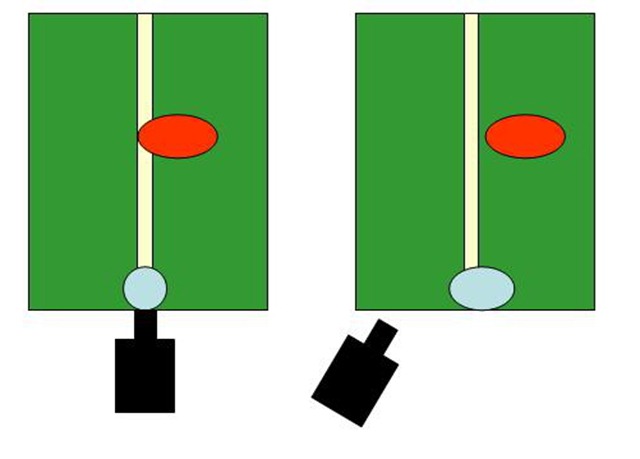
There’s a common factor between these two decisions, surprising as that may seem. In both cases, the TV camera was placed at an angle to the goal line. In the Toovey case, that camera happened to be at pretty much exactly the right angle to show clearly that the ball came off Toovey’s upper leg. In the Roffey decision, a camera at an angle to the goal line wasn’t able to show where the ball was, two metres above the ground, in relation to a line marked on the ground, as it was touched by a Sydney player’s hand.


It’s the angles that are the problem! In the Toovey case, the angle worked, but for almost every other case, it simply doesn’t allow a definitive judgement.


goalline video

When the camera is positioned right on the line, as in the left-hand illustration, there’s a reasonable chance of determining where the ball is in relation to the goal line (unless obscured by the goal post). In the right-hand illustration, that relationship between the ball and the line is changed by the angle. there can no longer by any certainty about where the ball is in relation to the line.


What’s the upshot of all this as we careen toward the end of the first video review season? Well, it’s obvious. The system as it is currently, works in a small percentage of cases but is useless for the majority. If the broadcaster or the AFL were to spring for sixteen or more, high-speed, high-definition, constantly-monitored goal line cameras, there’s a fair chance they’d eliminate about 90% of potential errors. That’s it.


Bring out the canvas curtain and administer the lead aspro before 2013. We were all much happier when Adrian and The Giesch thought there were only about six goal umpiring errors per season. Now we know there are more, but we can’t do a damned thing to remove them. Thanks for nothing, guys.

Read More

Tuesday, October 04, 2011

Giesch spin raises question

4 comments:

AFL Umpiring boss Jeff Gieschen has been rolled out after the Grand Final to perform his verbal pirouettes again, this time over the goal/behind to the Barcodes’ Sharrod Wellingham. Once more, the spectre of video referrals of goal umpiring decisions has been raised, even though the 2010 pre-season trial of the process was, in AussieRulesBlog’s view, an unmitigated waste of time.


But the big issue we should be focussing on is buried at the end of Gieschen’s statement on the matter. Discussing the process the on-field umpires went through in coming to the decision, he says:


"Our field umpire (Shaun Ryan) actually asked the two boundary umpires, who were both on the posts, what they thought [and] they couldn't add anything.
"He then asked the other field umpires.
"It would have been probably nice if we had gone back to the goal umpire as well."


So, was the decision made by the field umpire or the goal umpire? Why would it have been nice to go back to the goal umpire? Did the field umpire signal All Clear with two hands, suggesting a goal? Did the goal umpire change his decision on that basis?


Regardless, AussieRulesBlog thinks there’s far too much emphasis on mistakes by goal umpires. The error rate is minute. Both Chris Dawes and Tom Hawkins had gimme opportunities to score goals — and missed. Why aren’t we focussing on those incidents?


And if Gieschen is so damned worried about getting it as right as it can possibly be, what about looking at a consistent interpretation and application of the laws of the game from the first bounce of pre-season to the final siren of the Grand Final? Now THAT would be a step forward!


Release the Giesch!!!!!

Read More

Tuesday, September 27, 2011

Grand Final frees

No comments:

"The good thing for us as umpires is nothing changes. Free kicks are the same." says AFL umpire Shaun Ryan, one of the three umpires chosen to officiate at Saturday’s AFL Grand Final.


If only that were so, Shaun. If only it were so.


FWIW, AussieRulesBlog reckons Shaun is one of the best of the whistleblowers running around.


Release the Giesch!!!

Read More

Tuesday, September 20, 2011

Spin City — starring Jeff Gieschen

4 comments:
AFL umpiring administration
The Giesch has made one of his regular forays to Toyland (seen at right with two friends) with his rationalisation of the non-decision in the last stages of the West Coast–Carlton semi final.

The two bodies came together and there was contact, but if you put his arm out straight and have your palm facing back, that was how his hand was. It wasn't a holding motion. Holding is when you clench your fist or wrap your arm around someone.”

OK, Jeff, so you clicked your shoes together and you’re not in Kansas any more (to mix fairy tales!). “… put his arm out straight . . . that’s how his hand was.”  Really? Have you seen the stills?

And we assume that your reference to clenching a fist means clenching a fist around something — like an arm or a handful of guernsey — but we have to tell you that there’s no definition of the holding action in the rules. The Laws simply refer to “holding”. So this palm facing back doesn’t equal holding stuff is your little conception of reality.

Of course we know that the AFL Umpiring Department regards the Laws of the Game more as a set of guidelines, but seriously, you have got a particularly firm grasp of yourself.

Now, AussieRulesBlog is as pleased to see Carlton lose as anyone, but that is a free kick either for holding (despite Gieschen’s spin) or for blocking Walker from being able to contest the ball.

It should also not escape notice that Gieschen spun a difference of twenty-four free kicks — yes, that’s 24, 39:15 — between the two halves of the game as the players making the ball their objective after half time.

“People say you throw your whistle away. But that's all about the players reading the play at half time and realising, if we want to win the game, we need to focus on the ball and cut out any little tactics.”

C’mon, Jeff. You expect us to believe that the Umpiring Department representative at the game didn’t have a word in the shell-pinks of the three field umpires and suggest they’d been a touch over-zealous? Oh, for crying out loud!

We also note the recent demise of one of the media world’s more outlandish reality shows — What’s your decision, on the AFL’s website. Jeff’s weekly spinning of his charges’ more egregious blunders hasn’t reappeared after round twenty-three. We wondered why we’d felt that disturbance in the force . . .

Release the Giesch!!!
Read More

Monday, September 12, 2011

Lost rules?

No comments:
We don’t think we’re being pedantic expecting that a foundation rule of Aussie Rules football be adhered to in the game’s elite competition. Actually, there were any number of rules not adhered to in watching the four finals this weekend, but we’ve got one in particular on our mind.


We think we saw instances in all four games of players being pushed in the back by a pursuing player. Certainly, the one pictured was as obvious as the nose on our face. Swan Ryan O’Keefe is pursued by Saint Brendon Goddard. Goddard can’t get close enough to attempt to grab O’Keefe, so he pushes him in the back — firmly and in full view — in an effort to unbalance him. No free kick.

AussieRulesBlog knows we can be slow on the uptake at times, but we were firmly convinced that even placing a hand on an opponent’s back was a free kick — or does that one only apply in marking contests, Jeff?

Not for the first time, we’re beginning to see the emergence of a new set of rules for the final series, culminating in a Grand Final that everyone will agree was umpired beautifully because the umpires “let the game go”.

AussieRulesBlog doesn’t have anything against the notion of a less interventionist umpiring style. In fact we think it would be a positive benefit for the game.

What we do have something against is inconsistency! The umpiring in the first game of pre-season and the Grand Final should be all but indistinguishable. Sadly, under the Gieschen Directorate, you could be forgiven for thinking you were watching two different sports — related perhaps, but different.

Is it too much to ask that a push in the back, a blatant, undisguised push in the back be paid as a free kick?

Release the Giesch!!!
Read More

Wednesday, August 17, 2011

Hudson 50 raises issues of consistency

No comments:

In light of the renewed focus on footy crowd behaviour, it’s strangely coincidental that AFL Umpiring boss, Jeff Gieschen, has confirmed the fifty-metre penalty against Bulldog Ben Hudson last weekend.


Hudson’s ‘crime’ was to raise his arms and loudly ask “What?” a couple of times in response to a free kick awarded against him.


AussieRulesBlog wants to take a slightly left-field look at this incident, but first we should all remember that rule 18.1 — the rule defining when fifty-metre penalties can be imposed — clause (d) reads:

behaves in an abusive, insulting, threatening or obscene manner towards an umpire or disputes the decision of an umpire;


No-one could realistically suggest that Hudson did anything other than dispute the decision. His actions and his voice cannot seriously have been construed as abusive, threatening, insulting or obscene.


We can’t fault the logic of imposing sanctions on AFL players for abuse, insult or threat as a role model for lesser competitions, yet the penalty against Hudson does feel somewhat at odds with what’s happening in the game in general at AFL level. We don’t have any research to support our anecdotal recollection.


The left field element comes from the NRL. We’ve been watching a bit of ‘british bulldog for big boys’ recently having acquired a taste for a winning team — Melbourne Storm — during the Bombers’ mid-season run of losses*. One aspect of NRL that is in stark contrast with AFL is players’ reactions to penalties against them. It’s not that there’s no dissent — and there isn’t — but there’s a level of deference and respect shown to referees that Andrew Demetriou and Jeff Gieschen could only dream of.


To muddy these waters still further, there’s the example of ‘Association’ football, or soccer, where referees are routinely confronted by excited players, manhandled by players.


As noted, we don’t have an issue with the elite competition providing a behaviour template for players (and others) in lesser competitions. Our issue is consistency. The Hudson penalty seems out of kilter with other, similar incidents; more an exception than an example of the prevailing application of the rule.


As always, consistency is the gold standard and, as usual, the AFL’s umpiring department doesn’t seem capable of providing it.


* We attended every game (in person in Melbourne and on TV in Perth) and stayed to the final siren regardless of the score.

Read More

Friday, July 29, 2011

This week's Rule of the Week

No comments:
Despite repeated emphatic denials by AFL executives, further evidence tonight in the North-Carlton game that there is a Rule of the Week.

Tonight, for the first time in our recollection, players caught with the ball and punching it to indicate "a genuine attempt to get rid of the ball" were penalised because they were, to quote the umpires, "punching the ball to themselves". We heard this from two separate umpires, so it has to be assumed it is an instruction rather than an idiosyncratic expression.

We don't have a problem with this new interpretation in general, but there are caveats. If the ball is being held in by an opponent, there should be no free kick.

Our big problem with the interpretation is that it hasn't applied previously in this season. The rule has to be that a free kick interpretation for round one of the pre-season is exactly the same as the free kick interpretation in the last thirty seconds of the Grand Final. This interpretation has appeared out of nowhere for round 19. It's just not good enough.

Release the Giesch!!!!
Read More

Wednesday, July 27, 2011

July Fools Day

No comments:
Hold on readers. Lance Franklin has just been effectively wiped out of elite level AFL football!

Speaking on the AFL's What's Your Decision web show, AFL umpiring department boss Jeff Gieschen says Docker Hayden Ballantyne's after the siren shot in last weekend's Western Derby should have been disallowed because Ballantyne ran off the direct line between himself and the spot nominated as "the mark" by the umpire.

We're not sure if Jeff has watched many games recently, but the are a number of players who take somewhat circuitous runups when kicking, none moreso than the aforementioned Lance Franklin.

So, AussieRulesBlog checked our calendar to make sure it wasn't April Fools Day (it's not). Now we can hardly wait for the next Hawthorn game and for Franklin to take a mark or be awarded a free kick.

Seriously, can Gieschen's credibility diminish any further?
Read More

Monday, July 11, 2011

AussieRulesBlog apologises

No comments:

Regular AussieRulesBlog readers will know that our most fervent wish is for consistency of application of the rules of the game from the first bounce of pre-season to the final siren in the Grand Final.


Over recent weeks we’ve posted a series of articles focusing on particular rules in a bid to assist people to a better understanding of the rules and consequently better-informed criticism of on-field officiating.


We watched only three games over the weekend just past, but it would be hard to imagine three more different umpiring performances.


Friday night saw the spellbinding clash between the Cats and the Weagles. We didn’t get to the end of the game thinking that the umpires had had any real influence on the game and there weren’t any umpiring clangers that stuck in our mind.


Fast forward to Saturday night and perhaps the most puzzling and inconsistent umpiring performance of the year in the first half. Now, it’s fair to say that the Bombers–Cats game of the previous weekend was champagne football befitting Moet & Chandon. We don’t think we’d get much argument that the first half of the Bombers–Tigers game only merited used dishwashing water by comparison. And it wasn’t helped by three umpires with three seemingly different and interchangeable interpretations of everything from marking to holding the ball.


To round out the weekend, we took in the Bulldogs–Blues game on Foxtel. A great win for the Doggies against a Carlton seemingly believing all the hype about themselves. A great game marred by appalling umpiring. We can only recall one holding the man free kick, quite late in the game, despite countless significant holds after disposal. It’s like these three umpires had ripped the rule book to shreds and just picked up a few randomly selected pages to use for this particular game.


Not to put too fine a point on it, two goals directly from maniacally over-zealous fifty-metre penalties made Carlton’s effort look a lot better than it actually was.


AussieRulesBlog understands that the umpires at AFL level have an extremely difficult job. We understand that having run kilometers while making many often finely-nuanced judgements isn’t an easy gig. But when, as happened in the third quarter of the Bulldogs–Carlton game, a player is held for around two seconds after disposing of the ball and the umpire is clearly looking directly at this happening, but does not award a free kick, we think the way the game is being umpired has become a joke.


This game of ours is too important for there to be, no matter how much The Giesch may deny it, a “rule of the week”. Our game is too important to the fabric of our society for the emphasis and interpretation of the laws of the game to vary in the way that they do.


If Andrew Demetriou and Adrian Anderson seriously believe that Jeff Gieschen and Rowan Sawers are doing a competent job of running the umpiring department, then they need to come and spend some time in the stands with the fans who keep the game alive. Better educating fans to understand the rules is a waste of time when there is such blatant inconsistency.


AussieRulesBlog apologises for running our series of posts focussing on the rules. We’ve mislead our readers badly. An understanding of the rules is a waste of time, because the umpiring department changes, adds and discards rules and interpretations on a whim.


Andrew? Adrian? This situation has to be dealt with. Gieschen has to go. And if you won’t see him on his way, then you have to go.

Read More

Tuesday, June 21, 2011

Focus on Rules IIa: Advantage

2 comments:
Here at AussieRulesBlog Central we were forcing ourselves to watch the Bombers go down to North again and we noticed, at the start of the third quarter, an umpire call back a player-initiated advantage because “there’s no advantage”. We’re pretty sure we’ve seen this in another game some time over the past couple of weekends too.

As we noted in our Focus on Rules II: Advantage post, for the 2011 season the Law was rewritten to incorporate player-initiated advantage and the provision for the umpire to call the ball back where there is no advantage (17.3.2) was removed.

We don’t know why we’re surprised, but there seems to have been a change in the way this Law is being implemented in the last couple of weeks. We can only assume that The Giesch has seen the criticism and responded in the only way he knows how — by changing the level playing field while the game is being played!

Jeff, is there even the faintest chance that we could see a Law interpreted in the same way for one whole season? This really is beyond a joke.

Release the Giesch!!!!
Read More

Thursday, April 28, 2011

Footy officialdom out of touch

No comments:

Umpires and tribunals are a necessary part of our game. Without them, the game we Aussie Rules aficionados love would be little more than a brawl in a paddock. So, with that responsibility, it’s verging on disastrous that footy officialdom is so out of touch with practical reality.


Few would argue that the out of bounds on the full and deliberate out of bounds rules have generally improved the game as a spectacle. Few also would argue that there are countless occasions in each game where players ‘deliberately’ take the ball over the boundary line where there is no practical means for them to stop or otherwise keep the ball in play.


Jeff Gieschen’s spin on the Montagna kick last Thursday is as pure an example as could be imagined of defending the indefensible. If that kick is penalised, then every player who crosses the boundary while ‘fumbling’ the ball must also be penalised.


To add to the AFL’s woes, the MRP decides that Matthew Scarlett’s headcrashing elbow is a "legitimate spoiling action" that caused "accidental" high contact. For goodness sake! The only accidental contact was the contact Scarlett made with the ball!


Worse, the MRP’s analysis of Scarlett’s actions brings into question the whole rationale for free kicks paid for incidental contact. Surely these too should be deemed “accidental” and free of penalty?


Both the MRP and the umpiring department have utterly lost the confidence of the paying customer. The game may appear to be healthy after a bumper round of tight and interesting games, but umpiring and tribunal decisions that defy common logic risk the game’s ongoing health.


Release the Giesch!!!  . . .and the MRP!

Read More

Saturday, April 23, 2011

Gieschen!

No comments:

AussieRulesBlog has noticed in a couple of this week’s games that umpires’ boss Jeff Gieschen has ordained a new and devastating interpretation of holding the man — well devastating for the Adelaide Crows anyway!


It’s not that long ago — four or five weeks? — that a player making a tackle was penalised if the player he tackled was held for a micro second after ‘disposing’ of the ball. Well, that interpretation has been well and truly shelved.


Tonight, the Crows were denied three crucial free kicks in the midfield in the last minutes of the game as they pressed to extend their hard-won lead over the Blues. In each case, the Adelaide player was slung in the tackle after the ball had spilled loose. Not to put too fine a point on it, the Crows were probably cost the game by these non-decisions. Clearly, by their expressions and gestures, the Adelaide players expected free kicks.


Thank the umpires Blues fans, because they got you the game.


Regular readers will be aware that AussieRulesBlog fights for consistency in umpiring. We don’t care if the decision is wrong, as long as it is interpreted consistently the same way every game and every week of the season.


Instead, what we get under the Gieschen Ascendency is constantly-changing interpretations leaving players, coaches and fans utterly bewildered.


What is there left to say? You guessed it! RELEASE THE GIESCH!!!!!!!

Read More

Tuesday, February 15, 2011

Video review. . . and review . . .

No comments:

AFL Umpiring Director, Jeff Gieschen, was happy with the video review of the Barcodes’ Chris Dawes’ goal on Saturday night. All we can say to that is that Gieschen is easily pleased!


For those who missed the spectacle, Dawes snapped for goal and an opponent’s hand was in the same postcode. The field umpire, the closest official to the kick and attempted smother, called “All clear!”. At that point, the goal umpire ran out onto the field and suggested he wasn’t sure if the ball had been touched off the boot — despite a closer official ruling it all clear!


Next, we endured six or seven replays of varying speeds from a couple of different angles, none of which was conclusive. This process stretched over what felt like the best part of a minute.


Once again, AussieRulesBlog draws attention to the inequities of the initial process involved. Had the score been adjudicated as a behind, there is no opportunity for a video replay because the opposition will have grabbed a spare ball and kicked it into play. To deny them this capability, by holding up play to review the video, disadvantages them enormously.


Gieschen seems to think that getting the decision right is the acme of achievement.


Well, yes it is — in certain circumstances. Will we eventually fit high-powered lasers to the goal posts so that a ball that would brush an infinitely high post would be singed or burst, thus signifying a behind? We think there’s a point (no pun intended) where getting the decision right becomes less important than retaining basic fairness and keeping the momentum of the game.


In this implementation of the video review, teams awarded behinds incorrectly are disadvantaged and teams awarded goals are overly advantaged, because even if the original call of a goal is overturned they can set up their best defensive zone.


Thus far, we’ve only fleetingly mentioned the time involved in the review process. As we have pointed out previously, games like cricket and NFL have natural rhythms which facilitate video review. AFL does not.


In a lower-scoring game, where each score assumes much greater importance, there would be some justification for assistive technology being employed. In AFL, even if scores are within a few points at the final siren, there have generally been many scores and scoring chances, so that one error isn’t as critical.


“You wouldn't want to cut off the review without seeing all of the replays. If something bobbed up later then you'd look silly if you'd made the call on the first couple of replays,” Gieschen is quoted as saying.


If it’s so important to not look silly, Jeff, what about introducing video review of field umpiring gaffes. There are far more of these than goal umpiring errors. Adrian Anderson told us last year the goal umpiring error rate was less than ten in ten thousand, and yet we’re going to this ludicrous effort to reduce that rate?


The truth is, there’s just nowhere that this video review notion stacks up. In true AFL tradition, it’s using a bulldozer to knock over a single blade of grass.

Read More

Saturday, December 25, 2010

2010 as we saw it

No comments:
January
Who can forget the fallout from the Blues’ players pre-Christmes ‘booze cruise’? Club culture was our constant companion through a very quiet month.

Reports of AFLPA draftee induction camps gave us hope that, eventually, we shouldn’t have to endure the infantile antics of AFL footballers.

Later in the year, 18-year NFL veteran, Brett Favre, demonstrated this is a forelorn hope with his ‘sexting’.

February
As we prepared to get into the semi-serious stuff of the pre-season competition, the AFL gave bloggers a late Christmas present by revealing its so-called staging sanctions. Confusion reigned with almost everybody expecting players staging for a free kick in a marking contest to be free kicked or reported. Hardly anyone took the trouble to watch the video and understand what the AFL actually intended.

Temporary Saints recruit, Andrew Lovett, who already hadn’t managed to hit it off with his new teammates, found himself facing a rape charge and his new club finding him guilty without the benefit of a trial.

As the pre-season comp got underway, there was plenty of controversy with an apparent video referral of a scoring decision resulting in the goal umpire’s call being overturned. Field umpires had got straight back into stride by paying free kicks based on what they thought had happened rather than what they’d seen and, following the lead of Stephen McBurney, keeping their whistles on a hair trigger.

March
As the FFA seduced some sections of the AFL world with deals to upgrade regional stadiums, the Saints descended into amateur hour with the most inept handling of a grievance against a player in AFL history.

The AFL umpiring department announced their somewhat hilarious sponsorship by spectacle retailers, OPSM, and then proceeded to umpire sensibly — to everyone’s surprise!

Finally, the season proper got underway and we had a bit of a rant about how media select BOGs.

April
The AFL’s long-standing desire to make the game more attractive was thrown into chaos by the proliferation of ugly milling packs where everyone was frightened to take possession of the ball.

We lauded Western Bullgog, Bob Murphy, and his old-fashioned notion of respect for opponents and the Magpies–Saints clash provided a gilt-edged example of disrespect. Not only that, but three other posts focussed on this game. In the meantime, Brendan Fevola managed to tick off another couple of deadly sins on his personal bucket list.

We penned another instalment in our campaign to remove The Giesch, this time for inflexible interpretations.

Melbourne Storm managed to outmuscle every other sport in the world for press column-centimetres for a few days.

May
The month began with us berating Jeff Gieschen. That was a surprise — not.

Some genius at the AFL decided the Demons and the umpires would look spectacular in (nearly) matching uniforms for the Breast cancer game. Demons players couldn’t find their teammates on the field and kept handballing to umpires.

Speculation bubbled along concerning the next big NRL convert to AFL (and will Greg Inglis now make it another?), Jeff Kennett inserted his foot firmly in his mouth over the Ben Cousins doco, followed in close order by senior coach Alastair Clarkson shooting his gob off.

The rushed behind rule became interesting with about sixty thousand definitions being flung around, none of them being one of several employed by the AFL umpires. We finished the month by writing off St Kilda, in the wake of Riewoldt’s hamstring and lamenting the demise of respect and sportsmanship on the AFL field.

June
The holding the ball rule, 50-metre penalties, the advantage rule interpretation, and Jeff Gieschen, occupied much of our attention in June, along with Stephen Baker’s mauling of Steve Johnson and chief umpiring zealot, Steve McBurney’s hair-trigger whistle.

July
Co-operative goal umpiring that still couldn’t get the decision right was in our sights as July began. But we managed to focus on non-umpiring topics as well!

Modern players’ penchant for dribbling the ball through for a goal caught our attention and indicated to us that these players are just show ponies.

Confusing and inconsistent Match Review Panel outcomes gave us some grief, while the emergence of Michael Barlow as a star for Fremantle suggested to us that home-grown, ‘mature’-age recruits would be a better bet than international fancies like the Bombers’ Irishman, Michael Quinn.

Mark Williams’ sacking by Port Adelaide brought to an end to his death of a thousand cuts, while debut umpire Corey Bowen’s five first-half 50-metre penalties against the Bombers had us almost apoplectic with rage. We didn’t have long to wait for retribution as Bowen didn’t feature in the list of umpires for matches played the following week!

Meanwhile, Jeff Gieschen fantasised that his charges umpired “to the DVD” each and every week! Yeah, sure Jeff, and we’re a dead ringer for George Clooney.

The AFL allowed a police-check armband for the Hawks and Saints, but no such leniency for the Bombers and their Clash for Cancer.

Einsteinian concepts of curved space were employed to justify Lance Franklin’s ‘natural arc’ when kicking for goal, to allow umpires not to call play on. Truly one of the more breathtaking rationalisations from Gieschen’s mob for the year.

August
Surprise, surprise, Steve McBurney and over-zealous umpiring caught our attention at the start of the month, but not quite as much as the huge cast we found encasing our left wrist and forearm, courtesy of a fall. A nicely snapped radius bone in what the medical fraternity know as a Colles fracture.

Jeff Gieschen, ignoring previous indiscretions by his charges in making scoring decisions, suggested talk and consultation would be more effective in weeding errors out of goal umpiring than an extra goal umpire at each end. We must conclude that goal umpires are extraordinarily well-paid, since the AFL seem incredibly reluctant to employ another eight of them!

Finally, the talk began that James Hird would replace Matthew Knights as Essendon coach. As we now know, Knights was gone by the end of the month and Hird was being very coy. Smoke? Fire? We remain unconvinced by the denials of preplanning.

September
We highlighted the MRP’s failure to act against blatant staging when Jarrad Waite lodged an Oscar-worthy entry against the Swans, while the AFL world debated the merits of free kicks that are “technically there, but . . .”

An exodus of almost biblical proportions at Brisbane in the previous summer and the failure of the big name import to have a meaningful impact on-field left the club looking rather sickly.

And then there was the Grand Final entertainment — a highlight of our year. This year’s baffling progress of the Premiership Cup from a tethered hot air balloon, through the hands of Tom Harley, to Peter McKenna and ‘Cowboy’ Neale was underwhelming in the extreme.

Fortunately, as we now know, the game itself lived up to all the hype and more. The Saints were a bee’s dick away from breaking their drought, needing only a mildly eccentric bounce of the ball for Steven Milne to goal in the dying seconds and secure the game. Instead the ball bounced at 120° and we were back the following week.

In a fitting finish to the on-field year, in the drawn Grand Final, emergency umpire Steve McBurney spent more time on the field than most of the players.

Oh, and, quite unexpectedly, James Hird was appointed coach of the Bombers, in case you missed that news!

October
Of course, the Grand Final replay imposed footy on October even more strongly than usual, with the ’Woods downing the Saints in no uncertain terms — sadly. AussieRulesBlog has no great affection for the Saints, but any day that Collingwood loses is a good day.

In the biggest jaw-dropping moment of the year, Saints coaches nominated perennial ‘rabbit-in-the-headlights’ Zac Dawson as their best player in the grand final replay.

Bomber Thompson left the Cats, taking the media world completely by surprise, and the impact of expansion teams on the Gold Coast and in Sydney meant we’d have a six-ring circus for the first round of the pre-season competition.

November
Once again taking everyone by surprise, Bomber Thompson was announced as senior assistant to James Hird at Essendon.

A trickle of assistant coaches leaving St Kilda became a flood, leaving coach Ross Lyon to book a telephone booth for the footy department’s Xmas party.

December
The FFA’s soap bubble of optimism for hosting the World Cup was unceremoniously burst, leaving Frank Lowy and Ben Buckley wearing egg makeup.

The Demons released their ‘cutting-edge’ new uniform, to a general yawn, Gary Ablett Jnr let it be known that Bomber Thompson’s problem was that he was trying to coach the football team and, just for good measure, the AFL announced another slew of temporary rule changes for the pre-season competition — some OK, some laughable.

And that’s how it was at AussieRulesBlog for 2010. We look forward to having our regular readers back for 2011 when, once again, we’ll prick a few balloons and renew our campaign to Release the Giesch!

Happy New Year and have a safe, enjoyable and productive 2011. Go Bombers!
Read More

Tuesday, May 18, 2010

Pressure now on AFL for a definition

2 comments:

Sunday’s free kick against Essendon’s Cale Hooker for a deliberately rushed behind, subsequently adjudicated as the correct decision by Giesch and Co, brings into sharp focus the extremely hazy definition of “pressure” in the context of this rule.


Hooker was a little further out from the goal line than Henry Slattery a few weeks earlier, but had lost his footing where Slattery maintained his. Koschitzke was three or four metres from Hooker and could reasonably have been expected to be moving quickly to tackle Hooker (that he wasn’t says more about Kosi than about the rule!). Slattery had Franklin a couple of metres behind him.


In neither case did the Essendon player get tackled across the goal line.


So, The Giesch says the Slattery decision was wrong, and Scott McLaren paid a price for it, and now says the Hooker decision was right.


AussieRulesBlog would be happy for both to be right, and many more besides, but once again ‘interpretations’ have left the game in a very murky place.


The issue for The Giesch now is to come up with an everyman explanation of “pressure” in the context of this rule — an everyman explanation that umpires can apply, correctly and consistently, in a split second; an everyman explanation that tells players precisely what they can and can’t do. Oh, and it would be useful if fans were let in on the secret too!

Read More

Sunday, April 18, 2010

A free by any other name. . .

No comments:

Rules of the Game

15.4.5 Prohibited Contact and Payment of Free Kick

A field Umpire shall award a Free Kick against a Player where he or she is satisfied that the Player has made Prohibited Contact with an opposition Player.


A Player makes Prohibited Contact with an opposition Player if he or she:

(b) pushes an opposition Player in the back, unless such contact is incidental to a Marking contest and the Player is legitimately Marking or attempting to Mark the football;

We reproduce part of the Rules of the Game document to remind readers of the total and complete reference within the rules to awarding a free kick for pushing in the back. Yes, that’s it. There’s nothing more.


Everything else we see on a weekly basis, such as “hands on/in the back” is someone’s interpretation of this rule. First and foremost, let’s just acknowledge that the hands in the back interpretation is a fair stretch from the rule as written. It will come as no surprise for us to inform you that there are squillions of similar examples. Some of the current interpretations would appear to actually directly contradict the rules as written.


So, what’s brought on this fever of research? We witnessed — well, we saw on television — an incident today where a player of team A deliberately dove in under two players of team B who were attempting to retrieve a loose ball on the ground. The dive caused both team B players to lose their footing and fall over the team A player. A free kick for a push in the back was paid to the team A player.


Let’s forget, just for a moment, that the television replay clearly showed that neither team B player had actually touched the team A player’s back — and that the camera angle was fairly closely aligned with the umpire’s point of view.


It seems to us that there is a substantial difference between a push — that is, an active force being applied by the offending player — and being caused to fall across the other player’s back by the other player’s own actions.


This is just one example where the application of an inflexible interpretation of a rule denies players natural justice. The team A player brought that situation upon himself by diving in where he did. Penalising the team B players makes them responsible for an action that they did not initiate.


Complex interpretations of rules and inflexible implementation of them are a blight on our game.


Release the Giesch!!


Having made the point above that the team B players did not appear to touch the team A player’s back according to the television replay, it would appear that the umpire(s) assumed that such a contact would have been made, and paid the free kick on that basis.


The free kick should only be paid when the umpire sees the infringement. Not when they imagine it, when they see it.

Read More

Monday, March 29, 2010

Umpires fade into the background

No comments:

It’s not a headline we could have predicted. Having seen all or most of five games from round one, we are concerned that alien bodysnatchers have abducted Jeff Gieschen and are conducting fiendish experiments on him while his doppelganger administers the AFL’s whistleblowers.


Calling occupants of interplanetary most extraordinary craft: Please keep Jeff, we like the way the doppelganger is going at the moment! (with apologies to The Carpenters).


There were some clanger decisions in each game, but we expect that will happen and they even out over the season.


The biggest “problem” was, the umpires having put the whistles in their pockets, fans are used to tiggy touchwood frees being plucked from nowhere, so we were screaming for frees to no avail. We’re sure most of us can learn to be sensible again.


Of course, we can’t be completely happy, so the holding the man/holding the ball rule interpretation needs some sprucing up, Alien Jeff. It seems at the moment that a bloke can pretty much drop the ball when tackled — whatever happened to incorrect disposal? — and then be held through a 720 with pike in a tuck position — whatever happened to holding the man? — without the sound of a whistle disturbing the game’s flow.


Now, we’re not looking for a return to the days of the Spanish Inquisition interpretations of the past few seasons, but a little mellowing of the current laissez faire approach would be appreciated.


We’re also appreciating a more mellow approach to the “You dragged it in and didn’t get rid of it!” so efficiently delivered by Steve McBurney (haven’t caught up with his game yet).


On the whole, the officiating has been quite . . . sensible. [If I turn ‘round, will I be in a Saints’ Board meeting parallel universe?]

Read More

Sunday, February 28, 2010

It’s radical interpretation time again

1 comment:

We at AussieRulesBlog can’t help noticing that the umpires are applying a new, far stricter interpretation of playing on after a free kick or mark. Players need only glance to one side, or so it seems, before an umpire yells “Play on!!” Where once a definite step off line was required, it seems a mere feint will do the trick now.


We shouldn’t be surprised. It’s a signature of the Gieschen umpires administration that new rules or new interpretations are applied with missionary zeal for some weeks before a (slightly) saner approach is adopted. When the one thing we all crave from the umpires is consistency, Gieschen’s approach guarantees disappointment.


While we’re on the subject, we also notice umpires giving players not shooting for goal substantially less time to settle and find a target than their goal-shooting counterparts. Again, in the name of consistency if nothing else, players should have twenty seconds to compose themselves before being invited to take their kick.


Gieschen’s penchant for different interpretations and application depending on circumstances creates unnecessary grey areas and reinforces the umpires’ current reputation for inconsistency.


A new season is beginning, so let us return to a well-loved theme — Release the Giesch!!!

Read More
Showing posts with label Jeff Gieschen. Show all posts

Not worth 1,000 words

The Giesch seems to think that all you need to understand the rules of the game is his precious DVD. We’re pretty sure he’s relying on the old adage that a picture is worth 1,000 words. He couldn’t be more wrong.


The proof, if any were needed, is the furore that has erupted these last two weeks over marking contests.


The rules around physical contact, as they’ve been stated in words since at least 2008, are very clear. In a marking contest — or any other physical contest on the field of play — it is legal to push an opponent in the side or in the chest with an open hand  as long as the ball is within 5 metres.


The umpire’s job is pretty simple under these conditions.

  • Was the ball within 5 metres? Yes or no?
  • Did player 1 push player 2 with an open hand? Yes or no?
  • Did player 1 push player 2 in the side or chest? Yes or no?


In each case, if the answer is Yes, the contact is legal. If the answer is No, a free kick must be awarded.


But that was too easy for The Giesch. He has overlaid so many “interpretations” over this rule that it is all but unrecognisable.


Were there two actions? Were there hands in the back? It doesn’t matter! Was the ball within 5 metres and was the push with an open hand to the chest or side? Any No means a free kick must be awarded against the pushing player. It’s simple!


And the DVD? Well, sure it shows half a dozen examples of pushing in marking contests, but it’s far from definitive. There’re so many potential scenarios that a few pieces of video footage just can’t cut the mustard. The umpires, and the players, must have a firm foundation for understanding what is legal and what isn’t. That previously firm foundation, the written rules, has been eroded as each new interpretation obscures more of it.


Players, for the most part, probably don’t read the rules of the game. They absorb them as they play from a young age. Today’s players began playing in a much less complicated Aussie Rules environment, and they struggle to cope with the seemingly unremittent change.


Umpires are, even at the elite level, the teachers of the game. Their decisions tell the players what they can and can’t get away with. As a player tests the boundaries, he gets free-kicked and pulls back.


In 2013, we have umpires who are either trigger-happy or hesitant — and with three of them on the field, there’s sure to be an unhealthy mix of surety and hesitance.


Despite what the Giesch would have us believe, umpiring interpretations are changing on an almost weekly basis. Sitting in the stands, watching on TV, it’s as obvious as the nose on The Giesch’s face. It’s no wonder umpires are unsure. And the players just don’t have a hope.


Release The Giesch, reclaim the game!

The Giesch throws away the rule book

On the AFL’s website tonight, The Giesch makes a not-very-astounding assertion:


Last week, Brisbane Lions midfielder Tom Rockliff labeled the pushing rule 'bizarre', claiming he was unaware he could not push any player in a marking contest.

Rockliff's remarks have surprised Gieschen, who says it is outlined on the Rules of the Game DVD.

The problem, Jeff, is that the 2013 Laws of Australian Football says you can push a player (in the side or the chest) in a marking contest — as long as the ball is within 5 metres.


Forget the DVD, Jeff. Get your mob to umpire to the rules that are written in the book. There’s a fair chance that we’ll get something that resembles football out of it.


Release the Giesch and reclaim the game.

Video not up to the job

Tim Lane makes some very valid points about video decision assistance in general and the AFL’s system specifically.


The Toovey decision, where the camera positioning was serendipitously perfect to deliver a conclusive amendment to what the goal umpire had perceived, seems to prove the case that using video technology makes the game better by helping to get the decisions as right as they can be.


And the goal called by goal umpire Chelsea Roffey where the ball may have been touched as it crossed the line proves yet again, if such proof were needed, just how imperfect the AFL’s system is and how there may never be anything that approaches perfect.


There’s a common factor between these two decisions, surprising as that may seem. In both cases, the TV camera was placed at an angle to the goal line. In the Toovey case, that camera happened to be at pretty much exactly the right angle to show clearly that the ball came off Toovey’s upper leg. In the Roffey decision, a camera at an angle to the goal line wasn’t able to show where the ball was, two metres above the ground, in relation to a line marked on the ground, as it was touched by a Sydney player’s hand.


It’s the angles that are the problem! In the Toovey case, the angle worked, but for almost every other case, it simply doesn’t allow a definitive judgement.


goalline video

When the camera is positioned right on the line, as in the left-hand illustration, there’s a reasonable chance of determining where the ball is in relation to the goal line (unless obscured by the goal post). In the right-hand illustration, that relationship between the ball and the line is changed by the angle. there can no longer by any certainty about where the ball is in relation to the line.


What’s the upshot of all this as we careen toward the end of the first video review season? Well, it’s obvious. The system as it is currently, works in a small percentage of cases but is useless for the majority. If the broadcaster or the AFL were to spring for sixteen or more, high-speed, high-definition, constantly-monitored goal line cameras, there’s a fair chance they’d eliminate about 90% of potential errors. That’s it.


Bring out the canvas curtain and administer the lead aspro before 2013. We were all much happier when Adrian and The Giesch thought there were only about six goal umpiring errors per season. Now we know there are more, but we can’t do a damned thing to remove them. Thanks for nothing, guys.

Giesch spin raises question

AFL Umpiring boss Jeff Gieschen has been rolled out after the Grand Final to perform his verbal pirouettes again, this time over the goal/behind to the Barcodes’ Sharrod Wellingham. Once more, the spectre of video referrals of goal umpiring decisions has been raised, even though the 2010 pre-season trial of the process was, in AussieRulesBlog’s view, an unmitigated waste of time.


But the big issue we should be focussing on is buried at the end of Gieschen’s statement on the matter. Discussing the process the on-field umpires went through in coming to the decision, he says:


"Our field umpire (Shaun Ryan) actually asked the two boundary umpires, who were both on the posts, what they thought [and] they couldn't add anything.
"He then asked the other field umpires.
"It would have been probably nice if we had gone back to the goal umpire as well."


So, was the decision made by the field umpire or the goal umpire? Why would it have been nice to go back to the goal umpire? Did the field umpire signal All Clear with two hands, suggesting a goal? Did the goal umpire change his decision on that basis?


Regardless, AussieRulesBlog thinks there’s far too much emphasis on mistakes by goal umpires. The error rate is minute. Both Chris Dawes and Tom Hawkins had gimme opportunities to score goals — and missed. Why aren’t we focussing on those incidents?


And if Gieschen is so damned worried about getting it as right as it can possibly be, what about looking at a consistent interpretation and application of the laws of the game from the first bounce of pre-season to the final siren of the Grand Final? Now THAT would be a step forward!


Release the Giesch!!!!!

Grand Final frees

"The good thing for us as umpires is nothing changes. Free kicks are the same." says AFL umpire Shaun Ryan, one of the three umpires chosen to officiate at Saturday’s AFL Grand Final.


If only that were so, Shaun. If only it were so.


FWIW, AussieRulesBlog reckons Shaun is one of the best of the whistleblowers running around.


Release the Giesch!!!

Spin City — starring Jeff Gieschen

AFL umpiring administration
The Giesch has made one of his regular forays to Toyland (seen at right with two friends) with his rationalisation of the non-decision in the last stages of the West Coast–Carlton semi final.

The two bodies came together and there was contact, but if you put his arm out straight and have your palm facing back, that was how his hand was. It wasn't a holding motion. Holding is when you clench your fist or wrap your arm around someone.”

OK, Jeff, so you clicked your shoes together and you’re not in Kansas any more (to mix fairy tales!). “… put his arm out straight . . . that’s how his hand was.”  Really? Have you seen the stills?

And we assume that your reference to clenching a fist means clenching a fist around something — like an arm or a handful of guernsey — but we have to tell you that there’s no definition of the holding action in the rules. The Laws simply refer to “holding”. So this palm facing back doesn’t equal holding stuff is your little conception of reality.

Of course we know that the AFL Umpiring Department regards the Laws of the Game more as a set of guidelines, but seriously, you have got a particularly firm grasp of yourself.

Now, AussieRulesBlog is as pleased to see Carlton lose as anyone, but that is a free kick either for holding (despite Gieschen’s spin) or for blocking Walker from being able to contest the ball.

It should also not escape notice that Gieschen spun a difference of twenty-four free kicks — yes, that’s 24, 39:15 — between the two halves of the game as the players making the ball their objective after half time.

“People say you throw your whistle away. But that's all about the players reading the play at half time and realising, if we want to win the game, we need to focus on the ball and cut out any little tactics.”

C’mon, Jeff. You expect us to believe that the Umpiring Department representative at the game didn’t have a word in the shell-pinks of the three field umpires and suggest they’d been a touch over-zealous? Oh, for crying out loud!

We also note the recent demise of one of the media world’s more outlandish reality shows — What’s your decision, on the AFL’s website. Jeff’s weekly spinning of his charges’ more egregious blunders hasn’t reappeared after round twenty-three. We wondered why we’d felt that disturbance in the force . . .

Release the Giesch!!!

Lost rules?

We don’t think we’re being pedantic expecting that a foundation rule of Aussie Rules football be adhered to in the game’s elite competition. Actually, there were any number of rules not adhered to in watching the four finals this weekend, but we’ve got one in particular on our mind.


We think we saw instances in all four games of players being pushed in the back by a pursuing player. Certainly, the one pictured was as obvious as the nose on our face. Swan Ryan O’Keefe is pursued by Saint Brendon Goddard. Goddard can’t get close enough to attempt to grab O’Keefe, so he pushes him in the back — firmly and in full view — in an effort to unbalance him. No free kick.

AussieRulesBlog knows we can be slow on the uptake at times, but we were firmly convinced that even placing a hand on an opponent’s back was a free kick — or does that one only apply in marking contests, Jeff?

Not for the first time, we’re beginning to see the emergence of a new set of rules for the final series, culminating in a Grand Final that everyone will agree was umpired beautifully because the umpires “let the game go”.

AussieRulesBlog doesn’t have anything against the notion of a less interventionist umpiring style. In fact we think it would be a positive benefit for the game.

What we do have something against is inconsistency! The umpiring in the first game of pre-season and the Grand Final should be all but indistinguishable. Sadly, under the Gieschen Directorate, you could be forgiven for thinking you were watching two different sports — related perhaps, but different.

Is it too much to ask that a push in the back, a blatant, undisguised push in the back be paid as a free kick?

Release the Giesch!!!

Hudson 50 raises issues of consistency

In light of the renewed focus on footy crowd behaviour, it’s strangely coincidental that AFL Umpiring boss, Jeff Gieschen, has confirmed the fifty-metre penalty against Bulldog Ben Hudson last weekend.


Hudson’s ‘crime’ was to raise his arms and loudly ask “What?” a couple of times in response to a free kick awarded against him.


AussieRulesBlog wants to take a slightly left-field look at this incident, but first we should all remember that rule 18.1 — the rule defining when fifty-metre penalties can be imposed — clause (d) reads:

behaves in an abusive, insulting, threatening or obscene manner towards an umpire or disputes the decision of an umpire;


No-one could realistically suggest that Hudson did anything other than dispute the decision. His actions and his voice cannot seriously have been construed as abusive, threatening, insulting or obscene.


We can’t fault the logic of imposing sanctions on AFL players for abuse, insult or threat as a role model for lesser competitions, yet the penalty against Hudson does feel somewhat at odds with what’s happening in the game in general at AFL level. We don’t have any research to support our anecdotal recollection.


The left field element comes from the NRL. We’ve been watching a bit of ‘british bulldog for big boys’ recently having acquired a taste for a winning team — Melbourne Storm — during the Bombers’ mid-season run of losses*. One aspect of NRL that is in stark contrast with AFL is players’ reactions to penalties against them. It’s not that there’s no dissent — and there isn’t — but there’s a level of deference and respect shown to referees that Andrew Demetriou and Jeff Gieschen could only dream of.


To muddy these waters still further, there’s the example of ‘Association’ football, or soccer, where referees are routinely confronted by excited players, manhandled by players.


As noted, we don’t have an issue with the elite competition providing a behaviour template for players (and others) in lesser competitions. Our issue is consistency. The Hudson penalty seems out of kilter with other, similar incidents; more an exception than an example of the prevailing application of the rule.


As always, consistency is the gold standard and, as usual, the AFL’s umpiring department doesn’t seem capable of providing it.


* We attended every game (in person in Melbourne and on TV in Perth) and stayed to the final siren regardless of the score.

This week's Rule of the Week

Despite repeated emphatic denials by AFL executives, further evidence tonight in the North-Carlton game that there is a Rule of the Week.

Tonight, for the first time in our recollection, players caught with the ball and punching it to indicate "a genuine attempt to get rid of the ball" were penalised because they were, to quote the umpires, "punching the ball to themselves". We heard this from two separate umpires, so it has to be assumed it is an instruction rather than an idiosyncratic expression.

We don't have a problem with this new interpretation in general, but there are caveats. If the ball is being held in by an opponent, there should be no free kick.

Our big problem with the interpretation is that it hasn't applied previously in this season. The rule has to be that a free kick interpretation for round one of the pre-season is exactly the same as the free kick interpretation in the last thirty seconds of the Grand Final. This interpretation has appeared out of nowhere for round 19. It's just not good enough.

Release the Giesch!!!!

July Fools Day

Hold on readers. Lance Franklin has just been effectively wiped out of elite level AFL football!

Speaking on the AFL's What's Your Decision web show, AFL umpiring department boss Jeff Gieschen says Docker Hayden Ballantyne's after the siren shot in last weekend's Western Derby should have been disallowed because Ballantyne ran off the direct line between himself and the spot nominated as "the mark" by the umpire.

We're not sure if Jeff has watched many games recently, but the are a number of players who take somewhat circuitous runups when kicking, none moreso than the aforementioned Lance Franklin.

So, AussieRulesBlog checked our calendar to make sure it wasn't April Fools Day (it's not). Now we can hardly wait for the next Hawthorn game and for Franklin to take a mark or be awarded a free kick.

Seriously, can Gieschen's credibility diminish any further?

AussieRulesBlog apologises

Regular AussieRulesBlog readers will know that our most fervent wish is for consistency of application of the rules of the game from the first bounce of pre-season to the final siren in the Grand Final.


Over recent weeks we’ve posted a series of articles focusing on particular rules in a bid to assist people to a better understanding of the rules and consequently better-informed criticism of on-field officiating.


We watched only three games over the weekend just past, but it would be hard to imagine three more different umpiring performances.


Friday night saw the spellbinding clash between the Cats and the Weagles. We didn’t get to the end of the game thinking that the umpires had had any real influence on the game and there weren’t any umpiring clangers that stuck in our mind.


Fast forward to Saturday night and perhaps the most puzzling and inconsistent umpiring performance of the year in the first half. Now, it’s fair to say that the Bombers–Cats game of the previous weekend was champagne football befitting Moet & Chandon. We don’t think we’d get much argument that the first half of the Bombers–Tigers game only merited used dishwashing water by comparison. And it wasn’t helped by three umpires with three seemingly different and interchangeable interpretations of everything from marking to holding the ball.


To round out the weekend, we took in the Bulldogs–Blues game on Foxtel. A great win for the Doggies against a Carlton seemingly believing all the hype about themselves. A great game marred by appalling umpiring. We can only recall one holding the man free kick, quite late in the game, despite countless significant holds after disposal. It’s like these three umpires had ripped the rule book to shreds and just picked up a few randomly selected pages to use for this particular game.


Not to put too fine a point on it, two goals directly from maniacally over-zealous fifty-metre penalties made Carlton’s effort look a lot better than it actually was.


AussieRulesBlog understands that the umpires at AFL level have an extremely difficult job. We understand that having run kilometers while making many often finely-nuanced judgements isn’t an easy gig. But when, as happened in the third quarter of the Bulldogs–Carlton game, a player is held for around two seconds after disposing of the ball and the umpire is clearly looking directly at this happening, but does not award a free kick, we think the way the game is being umpired has become a joke.


This game of ours is too important for there to be, no matter how much The Giesch may deny it, a “rule of the week”. Our game is too important to the fabric of our society for the emphasis and interpretation of the laws of the game to vary in the way that they do.


If Andrew Demetriou and Adrian Anderson seriously believe that Jeff Gieschen and Rowan Sawers are doing a competent job of running the umpiring department, then they need to come and spend some time in the stands with the fans who keep the game alive. Better educating fans to understand the rules is a waste of time when there is such blatant inconsistency.


AussieRulesBlog apologises for running our series of posts focussing on the rules. We’ve mislead our readers badly. An understanding of the rules is a waste of time, because the umpiring department changes, adds and discards rules and interpretations on a whim.


Andrew? Adrian? This situation has to be dealt with. Gieschen has to go. And if you won’t see him on his way, then you have to go.

Focus on Rules IIa: Advantage

Here at AussieRulesBlog Central we were forcing ourselves to watch the Bombers go down to North again and we noticed, at the start of the third quarter, an umpire call back a player-initiated advantage because “there’s no advantage”. We’re pretty sure we’ve seen this in another game some time over the past couple of weekends too.

As we noted in our Focus on Rules II: Advantage post, for the 2011 season the Law was rewritten to incorporate player-initiated advantage and the provision for the umpire to call the ball back where there is no advantage (17.3.2) was removed.

We don’t know why we’re surprised, but there seems to have been a change in the way this Law is being implemented in the last couple of weeks. We can only assume that The Giesch has seen the criticism and responded in the only way he knows how — by changing the level playing field while the game is being played!

Jeff, is there even the faintest chance that we could see a Law interpreted in the same way for one whole season? This really is beyond a joke.

Release the Giesch!!!!

Footy officialdom out of touch

Umpires and tribunals are a necessary part of our game. Without them, the game we Aussie Rules aficionados love would be little more than a brawl in a paddock. So, with that responsibility, it’s verging on disastrous that footy officialdom is so out of touch with practical reality.


Few would argue that the out of bounds on the full and deliberate out of bounds rules have generally improved the game as a spectacle. Few also would argue that there are countless occasions in each game where players ‘deliberately’ take the ball over the boundary line where there is no practical means for them to stop or otherwise keep the ball in play.


Jeff Gieschen’s spin on the Montagna kick last Thursday is as pure an example as could be imagined of defending the indefensible. If that kick is penalised, then every player who crosses the boundary while ‘fumbling’ the ball must also be penalised.


To add to the AFL’s woes, the MRP decides that Matthew Scarlett’s headcrashing elbow is a "legitimate spoiling action" that caused "accidental" high contact. For goodness sake! The only accidental contact was the contact Scarlett made with the ball!


Worse, the MRP’s analysis of Scarlett’s actions brings into question the whole rationale for free kicks paid for incidental contact. Surely these too should be deemed “accidental” and free of penalty?


Both the MRP and the umpiring department have utterly lost the confidence of the paying customer. The game may appear to be healthy after a bumper round of tight and interesting games, but umpiring and tribunal decisions that defy common logic risk the game’s ongoing health.


Release the Giesch!!!  . . .and the MRP!

Gieschen!

AussieRulesBlog has noticed in a couple of this week’s games that umpires’ boss Jeff Gieschen has ordained a new and devastating interpretation of holding the man — well devastating for the Adelaide Crows anyway!


It’s not that long ago — four or five weeks? — that a player making a tackle was penalised if the player he tackled was held for a micro second after ‘disposing’ of the ball. Well, that interpretation has been well and truly shelved.


Tonight, the Crows were denied three crucial free kicks in the midfield in the last minutes of the game as they pressed to extend their hard-won lead over the Blues. In each case, the Adelaide player was slung in the tackle after the ball had spilled loose. Not to put too fine a point on it, the Crows were probably cost the game by these non-decisions. Clearly, by their expressions and gestures, the Adelaide players expected free kicks.


Thank the umpires Blues fans, because they got you the game.


Regular readers will be aware that AussieRulesBlog fights for consistency in umpiring. We don’t care if the decision is wrong, as long as it is interpreted consistently the same way every game and every week of the season.


Instead, what we get under the Gieschen Ascendency is constantly-changing interpretations leaving players, coaches and fans utterly bewildered.


What is there left to say? You guessed it! RELEASE THE GIESCH!!!!!!!

Video review. . . and review . . .

AFL Umpiring Director, Jeff Gieschen, was happy with the video review of the Barcodes’ Chris Dawes’ goal on Saturday night. All we can say to that is that Gieschen is easily pleased!


For those who missed the spectacle, Dawes snapped for goal and an opponent’s hand was in the same postcode. The field umpire, the closest official to the kick and attempted smother, called “All clear!”. At that point, the goal umpire ran out onto the field and suggested he wasn’t sure if the ball had been touched off the boot — despite a closer official ruling it all clear!


Next, we endured six or seven replays of varying speeds from a couple of different angles, none of which was conclusive. This process stretched over what felt like the best part of a minute.


Once again, AussieRulesBlog draws attention to the inequities of the initial process involved. Had the score been adjudicated as a behind, there is no opportunity for a video replay because the opposition will have grabbed a spare ball and kicked it into play. To deny them this capability, by holding up play to review the video, disadvantages them enormously.


Gieschen seems to think that getting the decision right is the acme of achievement.


Well, yes it is — in certain circumstances. Will we eventually fit high-powered lasers to the goal posts so that a ball that would brush an infinitely high post would be singed or burst, thus signifying a behind? We think there’s a point (no pun intended) where getting the decision right becomes less important than retaining basic fairness and keeping the momentum of the game.


In this implementation of the video review, teams awarded behinds incorrectly are disadvantaged and teams awarded goals are overly advantaged, because even if the original call of a goal is overturned they can set up their best defensive zone.


Thus far, we’ve only fleetingly mentioned the time involved in the review process. As we have pointed out previously, games like cricket and NFL have natural rhythms which facilitate video review. AFL does not.


In a lower-scoring game, where each score assumes much greater importance, there would be some justification for assistive technology being employed. In AFL, even if scores are within a few points at the final siren, there have generally been many scores and scoring chances, so that one error isn’t as critical.


“You wouldn't want to cut off the review without seeing all of the replays. If something bobbed up later then you'd look silly if you'd made the call on the first couple of replays,” Gieschen is quoted as saying.


If it’s so important to not look silly, Jeff, what about introducing video review of field umpiring gaffes. There are far more of these than goal umpiring errors. Adrian Anderson told us last year the goal umpiring error rate was less than ten in ten thousand, and yet we’re going to this ludicrous effort to reduce that rate?


The truth is, there’s just nowhere that this video review notion stacks up. In true AFL tradition, it’s using a bulldozer to knock over a single blade of grass.

2010 as we saw it

January
Who can forget the fallout from the Blues’ players pre-Christmes ‘booze cruise’? Club culture was our constant companion through a very quiet month.

Reports of AFLPA draftee induction camps gave us hope that, eventually, we shouldn’t have to endure the infantile antics of AFL footballers.

Later in the year, 18-year NFL veteran, Brett Favre, demonstrated this is a forelorn hope with his ‘sexting’.

February
As we prepared to get into the semi-serious stuff of the pre-season competition, the AFL gave bloggers a late Christmas present by revealing its so-called staging sanctions. Confusion reigned with almost everybody expecting players staging for a free kick in a marking contest to be free kicked or reported. Hardly anyone took the trouble to watch the video and understand what the AFL actually intended.

Temporary Saints recruit, Andrew Lovett, who already hadn’t managed to hit it off with his new teammates, found himself facing a rape charge and his new club finding him guilty without the benefit of a trial.

As the pre-season comp got underway, there was plenty of controversy with an apparent video referral of a scoring decision resulting in the goal umpire’s call being overturned. Field umpires had got straight back into stride by paying free kicks based on what they thought had happened rather than what they’d seen and, following the lead of Stephen McBurney, keeping their whistles on a hair trigger.

March
As the FFA seduced some sections of the AFL world with deals to upgrade regional stadiums, the Saints descended into amateur hour with the most inept handling of a grievance against a player in AFL history.

The AFL umpiring department announced their somewhat hilarious sponsorship by spectacle retailers, OPSM, and then proceeded to umpire sensibly — to everyone’s surprise!

Finally, the season proper got underway and we had a bit of a rant about how media select BOGs.

April
The AFL’s long-standing desire to make the game more attractive was thrown into chaos by the proliferation of ugly milling packs where everyone was frightened to take possession of the ball.

We lauded Western Bullgog, Bob Murphy, and his old-fashioned notion of respect for opponents and the Magpies–Saints clash provided a gilt-edged example of disrespect. Not only that, but three other posts focussed on this game. In the meantime, Brendan Fevola managed to tick off another couple of deadly sins on his personal bucket list.

We penned another instalment in our campaign to remove The Giesch, this time for inflexible interpretations.

Melbourne Storm managed to outmuscle every other sport in the world for press column-centimetres for a few days.

May
The month began with us berating Jeff Gieschen. That was a surprise — not.

Some genius at the AFL decided the Demons and the umpires would look spectacular in (nearly) matching uniforms for the Breast cancer game. Demons players couldn’t find their teammates on the field and kept handballing to umpires.

Speculation bubbled along concerning the next big NRL convert to AFL (and will Greg Inglis now make it another?), Jeff Kennett inserted his foot firmly in his mouth over the Ben Cousins doco, followed in close order by senior coach Alastair Clarkson shooting his gob off.

The rushed behind rule became interesting with about sixty thousand definitions being flung around, none of them being one of several employed by the AFL umpires. We finished the month by writing off St Kilda, in the wake of Riewoldt’s hamstring and lamenting the demise of respect and sportsmanship on the AFL field.

June
The holding the ball rule, 50-metre penalties, the advantage rule interpretation, and Jeff Gieschen, occupied much of our attention in June, along with Stephen Baker’s mauling of Steve Johnson and chief umpiring zealot, Steve McBurney’s hair-trigger whistle.

July
Co-operative goal umpiring that still couldn’t get the decision right was in our sights as July began. But we managed to focus on non-umpiring topics as well!

Modern players’ penchant for dribbling the ball through for a goal caught our attention and indicated to us that these players are just show ponies.

Confusing and inconsistent Match Review Panel outcomes gave us some grief, while the emergence of Michael Barlow as a star for Fremantle suggested to us that home-grown, ‘mature’-age recruits would be a better bet than international fancies like the Bombers’ Irishman, Michael Quinn.

Mark Williams’ sacking by Port Adelaide brought to an end to his death of a thousand cuts, while debut umpire Corey Bowen’s five first-half 50-metre penalties against the Bombers had us almost apoplectic with rage. We didn’t have long to wait for retribution as Bowen didn’t feature in the list of umpires for matches played the following week!

Meanwhile, Jeff Gieschen fantasised that his charges umpired “to the DVD” each and every week! Yeah, sure Jeff, and we’re a dead ringer for George Clooney.

The AFL allowed a police-check armband for the Hawks and Saints, but no such leniency for the Bombers and their Clash for Cancer.

Einsteinian concepts of curved space were employed to justify Lance Franklin’s ‘natural arc’ when kicking for goal, to allow umpires not to call play on. Truly one of the more breathtaking rationalisations from Gieschen’s mob for the year.

August
Surprise, surprise, Steve McBurney and over-zealous umpiring caught our attention at the start of the month, but not quite as much as the huge cast we found encasing our left wrist and forearm, courtesy of a fall. A nicely snapped radius bone in what the medical fraternity know as a Colles fracture.

Jeff Gieschen, ignoring previous indiscretions by his charges in making scoring decisions, suggested talk and consultation would be more effective in weeding errors out of goal umpiring than an extra goal umpire at each end. We must conclude that goal umpires are extraordinarily well-paid, since the AFL seem incredibly reluctant to employ another eight of them!

Finally, the talk began that James Hird would replace Matthew Knights as Essendon coach. As we now know, Knights was gone by the end of the month and Hird was being very coy. Smoke? Fire? We remain unconvinced by the denials of preplanning.

September
We highlighted the MRP’s failure to act against blatant staging when Jarrad Waite lodged an Oscar-worthy entry against the Swans, while the AFL world debated the merits of free kicks that are “technically there, but . . .”

An exodus of almost biblical proportions at Brisbane in the previous summer and the failure of the big name import to have a meaningful impact on-field left the club looking rather sickly.

And then there was the Grand Final entertainment — a highlight of our year. This year’s baffling progress of the Premiership Cup from a tethered hot air balloon, through the hands of Tom Harley, to Peter McKenna and ‘Cowboy’ Neale was underwhelming in the extreme.

Fortunately, as we now know, the game itself lived up to all the hype and more. The Saints were a bee’s dick away from breaking their drought, needing only a mildly eccentric bounce of the ball for Steven Milne to goal in the dying seconds and secure the game. Instead the ball bounced at 120° and we were back the following week.

In a fitting finish to the on-field year, in the drawn Grand Final, emergency umpire Steve McBurney spent more time on the field than most of the players.

Oh, and, quite unexpectedly, James Hird was appointed coach of the Bombers, in case you missed that news!

October
Of course, the Grand Final replay imposed footy on October even more strongly than usual, with the ’Woods downing the Saints in no uncertain terms — sadly. AussieRulesBlog has no great affection for the Saints, but any day that Collingwood loses is a good day.

In the biggest jaw-dropping moment of the year, Saints coaches nominated perennial ‘rabbit-in-the-headlights’ Zac Dawson as their best player in the grand final replay.

Bomber Thompson left the Cats, taking the media world completely by surprise, and the impact of expansion teams on the Gold Coast and in Sydney meant we’d have a six-ring circus for the first round of the pre-season competition.

November
Once again taking everyone by surprise, Bomber Thompson was announced as senior assistant to James Hird at Essendon.

A trickle of assistant coaches leaving St Kilda became a flood, leaving coach Ross Lyon to book a telephone booth for the footy department’s Xmas party.

December
The FFA’s soap bubble of optimism for hosting the World Cup was unceremoniously burst, leaving Frank Lowy and Ben Buckley wearing egg makeup.

The Demons released their ‘cutting-edge’ new uniform, to a general yawn, Gary Ablett Jnr let it be known that Bomber Thompson’s problem was that he was trying to coach the football team and, just for good measure, the AFL announced another slew of temporary rule changes for the pre-season competition — some OK, some laughable.

And that’s how it was at AussieRulesBlog for 2010. We look forward to having our regular readers back for 2011 when, once again, we’ll prick a few balloons and renew our campaign to Release the Giesch!

Happy New Year and have a safe, enjoyable and productive 2011. Go Bombers!

Pressure now on AFL for a definition

Sunday’s free kick against Essendon’s Cale Hooker for a deliberately rushed behind, subsequently adjudicated as the correct decision by Giesch and Co, brings into sharp focus the extremely hazy definition of “pressure” in the context of this rule.


Hooker was a little further out from the goal line than Henry Slattery a few weeks earlier, but had lost his footing where Slattery maintained his. Koschitzke was three or four metres from Hooker and could reasonably have been expected to be moving quickly to tackle Hooker (that he wasn’t says more about Kosi than about the rule!). Slattery had Franklin a couple of metres behind him.


In neither case did the Essendon player get tackled across the goal line.


So, The Giesch says the Slattery decision was wrong, and Scott McLaren paid a price for it, and now says the Hooker decision was right.


AussieRulesBlog would be happy for both to be right, and many more besides, but once again ‘interpretations’ have left the game in a very murky place.


The issue for The Giesch now is to come up with an everyman explanation of “pressure” in the context of this rule — an everyman explanation that umpires can apply, correctly and consistently, in a split second; an everyman explanation that tells players precisely what they can and can’t do. Oh, and it would be useful if fans were let in on the secret too!

A free by any other name. . .

Rules of the Game

15.4.5 Prohibited Contact and Payment of Free Kick

A field Umpire shall award a Free Kick against a Player where he or she is satisfied that the Player has made Prohibited Contact with an opposition Player.


A Player makes Prohibited Contact with an opposition Player if he or she:

(b) pushes an opposition Player in the back, unless such contact is incidental to a Marking contest and the Player is legitimately Marking or attempting to Mark the football;

We reproduce part of the Rules of the Game document to remind readers of the total and complete reference within the rules to awarding a free kick for pushing in the back. Yes, that’s it. There’s nothing more.


Everything else we see on a weekly basis, such as “hands on/in the back” is someone’s interpretation of this rule. First and foremost, let’s just acknowledge that the hands in the back interpretation is a fair stretch from the rule as written. It will come as no surprise for us to inform you that there are squillions of similar examples. Some of the current interpretations would appear to actually directly contradict the rules as written.


So, what’s brought on this fever of research? We witnessed — well, we saw on television — an incident today where a player of team A deliberately dove in under two players of team B who were attempting to retrieve a loose ball on the ground. The dive caused both team B players to lose their footing and fall over the team A player. A free kick for a push in the back was paid to the team A player.


Let’s forget, just for a moment, that the television replay clearly showed that neither team B player had actually touched the team A player’s back — and that the camera angle was fairly closely aligned with the umpire’s point of view.


It seems to us that there is a substantial difference between a push — that is, an active force being applied by the offending player — and being caused to fall across the other player’s back by the other player’s own actions.


This is just one example where the application of an inflexible interpretation of a rule denies players natural justice. The team A player brought that situation upon himself by diving in where he did. Penalising the team B players makes them responsible for an action that they did not initiate.


Complex interpretations of rules and inflexible implementation of them are a blight on our game.


Release the Giesch!!


Having made the point above that the team B players did not appear to touch the team A player’s back according to the television replay, it would appear that the umpire(s) assumed that such a contact would have been made, and paid the free kick on that basis.


The free kick should only be paid when the umpire sees the infringement. Not when they imagine it, when they see it.

Umpires fade into the background

It’s not a headline we could have predicted. Having seen all or most of five games from round one, we are concerned that alien bodysnatchers have abducted Jeff Gieschen and are conducting fiendish experiments on him while his doppelganger administers the AFL’s whistleblowers.


Calling occupants of interplanetary most extraordinary craft: Please keep Jeff, we like the way the doppelganger is going at the moment! (with apologies to The Carpenters).


There were some clanger decisions in each game, but we expect that will happen and they even out over the season.


The biggest “problem” was, the umpires having put the whistles in their pockets, fans are used to tiggy touchwood frees being plucked from nowhere, so we were screaming for frees to no avail. We’re sure most of us can learn to be sensible again.


Of course, we can’t be completely happy, so the holding the man/holding the ball rule interpretation needs some sprucing up, Alien Jeff. It seems at the moment that a bloke can pretty much drop the ball when tackled — whatever happened to incorrect disposal? — and then be held through a 720 with pike in a tuck position — whatever happened to holding the man? — without the sound of a whistle disturbing the game’s flow.


Now, we’re not looking for a return to the days of the Spanish Inquisition interpretations of the past few seasons, but a little mellowing of the current laissez faire approach would be appreciated.


We’re also appreciating a more mellow approach to the “You dragged it in and didn’t get rid of it!” so efficiently delivered by Steve McBurney (haven’t caught up with his game yet).


On the whole, the officiating has been quite . . . sensible. [If I turn ‘round, will I be in a Saints’ Board meeting parallel universe?]

It’s radical interpretation time again

We at AussieRulesBlog can’t help noticing that the umpires are applying a new, far stricter interpretation of playing on after a free kick or mark. Players need only glance to one side, or so it seems, before an umpire yells “Play on!!” Where once a definite step off line was required, it seems a mere feint will do the trick now.


We shouldn’t be surprised. It’s a signature of the Gieschen umpires administration that new rules or new interpretations are applied with missionary zeal for some weeks before a (slightly) saner approach is adopted. When the one thing we all crave from the umpires is consistency, Gieschen’s approach guarantees disappointment.


While we’re on the subject, we also notice umpires giving players not shooting for goal substantially less time to settle and find a target than their goal-shooting counterparts. Again, in the name of consistency if nothing else, players should have twenty seconds to compose themselves before being invited to take their kick.


Gieschen’s penchant for different interpretations and application depending on circumstances creates unnecessary grey areas and reinforces the umpires’ current reputation for inconsistency.


A new season is beginning, so let us return to a well-loved theme — Release the Giesch!!!