Showing posts with label Video referral. Show all posts

Sunday, May 19, 2013

End this farce

No comments:

The only people who retain any vestige of faith in the video score review system foisted on us by the unlamented Adrian Anderson are the umpires.


For everyone else, it is a mortally-wounded beast that should be put out of its misery with a lead Aspro.


Please, Mark Evans, put it down. End our suffering.

Read More

Monday, April 29, 2013

Great expectations

No comments:

As some of the heat comes out of the goal line video review controversy, new AFL football operations boss Mark Evans thinks the only viable options open to him are to stick with an imperfect system or revert to goal umpires being the sole adjudicators.


Evans didn’t endorse the existing system, but saw nothing in the immediate future that would be an advance on it. The Age’s report quotes Evans as saying only one percent of scoring decisions were reviewed, with two decisions so far this year having been overturned by the review.


"At the moment, we have a system where we can correct the absolute errors and that's got to be better than not having it [at] all."


Well, AussieRulesBlog begs to differ, and here’s why.


The video review system as it stands is set up to fail. The only scenarios where it can deliver anything like certainty are those serendipitous occasions where the direction of the ball coincides with the direction of a camera and there is a sufficient deflection of the ball from an object to determine that the ball struck the object.


Anything else, save those occasions where the broadcaster has installed goalpost cameras, is a complete waste of time and energy.


Our prime reason for dissent is that the very fact of having, and utilising, a video review system implies that it will contribute meaningfully to the game. Just by using it, we create that expectation. It doesn’t matter how many times everybody says it is imperfect, the expectation will remain.


While the game remains hostage to the spurious logic that says we must employ any measure that we think might bring us closer to absolute accuracy, these controversies will continue, and will continue to be a blight on the game.


Thanks for nothing, Adrian.

Read More

Sunday, April 28, 2013

Give them an inch…

No comments:

Way back when this crock of a video referral system was being foreshadowed, AussieRulesBlog implored the powers that be to ensure that it remained about goal line decisions. Of course, as we now know, it has failed to deliver the promised certainty and accuracy on the goal line.


Unfortunately, there are umpires who continue to refer decisions about things other than scoring — an example being the decision in tonight’s Hawthorn–Kangaroos game to refer a decision about whether a Kangaroos player had touched a ball kicked for goal by a Hawthorn player.


As we have previously demonstrated, the physics of kicking clearly show that the cameras being used to cover AFL are incapable of clearly discerning whether a ball has been touched or not unless there is a significant movement of the touching hand.


It hasn’t been a good weekend for the Umpiring Department with multiple video clangers and a field umpire allowing Geelong to pinch a free kick awarded to the Bulldogs.

Read More

100% goal a step too far

No comments:

The goal umpiring furore erupting after Friday night’s Richmond-Fremantle game has shone yet another light on the AFL’s attempt to approach 100% correctness on scoring decisions — and what we see isn’t pretty.


For those who haven’t seen it, here’s the scenario:


goaldecision


The ball has been kicked toward goal from the left-hand pocket and has closely tracked the goal line as it travels toward the goal umpire. Richmond player #29, Ty Vickery, has just tried to nudge the ball through for a goal with his foot — but taken an air swing.


The ball proceeds on its way and strikes the goal umpire in the area close to his “family jewels”.


So, to the controversies.


Damien Hardwick claims the result should have been a goal to Richmond. Quite how this can be the case when the goal umpire is hit in the gonads as he stands against the post mystifies us. Yes, it was close. Yes, it would be preferable that the umpire wasn’t in such an immediate vicinity. But a goal? No.


Controversy number two has various commentators calling for the goal umpire to be standing back from the line, out of the way of the players. Once again, quite how the umpire would be in a position to make a judgement in this case were he standing a metre or two back from the line mystifies us.


Stand by for a shock! AussieRulesBlog thinks The Giesch’s bloke got this one spot on and was, in the circumstances and with the tools available, in EXACTLY the right position to make a judgement.


Let’s just revisit this whole goal umpiring area. When the video review notion was first raised, the departed and unlamented Adrian Anderson told us that goal umpiring errors were less than one-tenth of one percent of all goal umpiring decisions across a season. BUT, despite that laudable statistic, the AFL decided to make a kneejerk response to a couple of high-profile errors and introduce a remarkably-flawed goal line video decision assistance ‘system’.


In this system, the umpires would rely on broadcast TV camera footage to assist the decision-making process. The AFL decided they wouldn’t foot the bill for cameras in the goal posts to monitor the goal line, instead relying on the broadcasters’ cameras set at a significant angle to the goal line.


What has followed has been the longest series of cock-ups the game has ever seen. A small number of decisions have been shown to be wrong and been corrected, but at the cost of interminable furore and the regular intonation of “Inconclusive, goal umpire’s decision.”


This experiment in technology has been an unmitigated disaster. The logical decision, right at the start of the process, was to employ two goal umpires at either end of the ground. With responsibility for a roughly seven-metre stretch of goal-line plane each, there’s a much-reduced likelihood of error. It’s not eliminated completely, but, as we’ve seen in recent years, technology as it is currently employed doesn’t get us any nearer that goal.


The sticking point here is money. The AFL won’t open its wallet to fund goal-line cameras, and it won’t open its wallet to fund an extra two goal umpires per game.


It’s not that long ago that it was the AFL defending the antiquated notion that one boundary umpire could effectively cover 200 metres of boundary in a fast-moving game of football. Would anyone now countenance going back to a single boundary umpire?


Come on Andrew. Time to step up to the mark. Either fund the video review system properly, or spring for some extra umpires. It’s not like the AFL is poor.

Read More

Sunday, September 23, 2012

Video not up to the job

No comments:

Tim Lane makes some very valid points about video decision assistance in general and the AFL’s system specifically.


The Toovey decision, where the camera positioning was serendipitously perfect to deliver a conclusive amendment to what the goal umpire had perceived, seems to prove the case that using video technology makes the game better by helping to get the decisions as right as they can be.


And the goal called by goal umpire Chelsea Roffey where the ball may have been touched as it crossed the line proves yet again, if such proof were needed, just how imperfect the AFL’s system is and how there may never be anything that approaches perfect.


There’s a common factor between these two decisions, surprising as that may seem. In both cases, the TV camera was placed at an angle to the goal line. In the Toovey case, that camera happened to be at pretty much exactly the right angle to show clearly that the ball came off Toovey’s upper leg. In the Roffey decision, a camera at an angle to the goal line wasn’t able to show where the ball was, two metres above the ground, in relation to a line marked on the ground, as it was touched by a Sydney player’s hand.


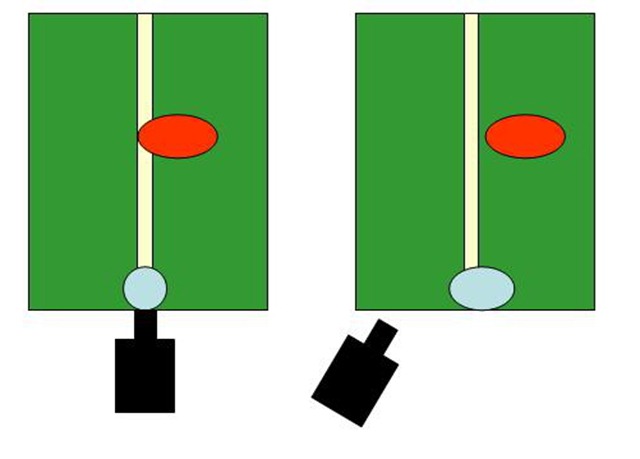
It’s the angles that are the problem! In the Toovey case, the angle worked, but for almost every other case, it simply doesn’t allow a definitive judgement.


goalline video

When the camera is positioned right on the line, as in the left-hand illustration, there’s a reasonable chance of determining where the ball is in relation to the goal line (unless obscured by the goal post). In the right-hand illustration, that relationship between the ball and the line is changed by the angle. there can no longer by any certainty about where the ball is in relation to the line.


What’s the upshot of all this as we careen toward the end of the first video review season? Well, it’s obvious. The system as it is currently, works in a small percentage of cases but is useless for the majority. If the broadcaster or the AFL were to spring for sixteen or more, high-speed, high-definition, constantly-monitored goal line cameras, there’s a fair chance they’d eliminate about 90% of potential errors. That’s it.


Bring out the canvas curtain and administer the lead aspro before 2013. We were all much happier when Adrian and The Giesch thought there were only about six goal umpiring errors per season. Now we know there are more, but we can’t do a damned thing to remove them. Thanks for nothing, guys.

Read More

Wednesday, July 18, 2012

AFL judicial system is broken

No comments:

So, let’s get this straight. Jack Ziebell’s collision with Aaron Joseph in a genuine contest for the ball is equivalent to Chris Judd wrenching an opponent’s arm whilst he is pinned with a player on top of him. Of course that’s a simplistic assessment, but the similarity of the penalty — a four-week holiday each, if you hadn’t heard — invites the comparison.


The old VFL/AFL Tribunal system may have been antiquated, time-consuming and, as we then thought, inconsistent, but compared to the hotch-potch inflicted on the game by Adrian Anderson it was simply wonderful.


There is no part of the current system that delivers consistency and most parts, including basic on-field officiating, are devoid of considerations of context. The system is, quite simply, broken and it’s author cannot credibly remain in his post. Don’t let the door hit your arse on the way out, Adrian.

Read More

Tuesday, May 01, 2012

Anderson’s video obsession

No comments:

Tomorrow morning’s meeting between Vlad and Adrian Anderson should be stirring stuff. AussieRulesBlog is rather glad we’re not in Anderson’s shoes.


In recent weeks, the hue and cry over the deficiencies of his much-vaunted goal line decision video referral ‘system’ has risen in a crescendo. It’s not that a few times it has actually worked: it’s more that the holes in the process make a Swiss cheese look solid.


Now, that other video obsession of the AFL’s football operations boss, the Match Review Panel, has been shown to be guessing when it charged the Saints’ Leigh Montagna with striking based on a review of game video footage.


“The MRP charged Montagna based on video footage, although the point at which Magner's eye was cut was inconclusive.”


It’s interesting that an inconclusive ‘goal line’ video apparently automatically reduces the score to the lesser option, but an inconclusive video at the MRP results in a charge and a penalty. That’s consistency for you, just like we get from the umpires week to week, quarter to quarter and decision to decision.


Still, we shouldn’t be surprised. It’s pretty clear from watching games that the AFL umpiring department is quite happy to have their field umpires guessing, so why should the MRP miss out on the fun?


Confidence in the video referral ‘system’ and the MRP is at just about rock bottom.


Here’s an idea, Vlad! If we have to have  video referrals and reviews, let’s base our decisions — goal line and Match review charges — on what we can actually see.

Read More

Friday, April 27, 2012

The Emperor’s new clothes

No comments:

The feedback [on the video review system]so far has been very positive” according to Adrian Anderson.


The first thought that comes to mind is Vlad parading around the G with not a stitch on and those providing the feedback on the video system telling him how fine he looks in his new threads.

Read More

Thursday, April 26, 2012

Video ‘system’ a crock

No comments:

In the wake of the epic Anzac Day game, debutante Barcodes coach Nathan Buckley chose to comment on the goal line video referral ‘system’, but his claim that the AFL have changed their process is simply incorrect.


From the start, where a video referral has been made, an inconclusive video has resulted in the lesser scoring result. As we noted two days ago, this underlying process results in the completely whacky premise that the lesser result is chosen not because there is any conclusive evidence that it is correct, but because there is no conclusive evidence that it is not correct.


An AFL spokesman quoted in the story on Buckley’s comments suggests that an inconclusive video goes back to what the umpire considered was the correct decision at the time. This is a lovely theory, but we can’t recall a single instance we’ve seen where it has happened [we acknowledge that we haven’t seen every game]. On any number of occasions, goal umpires about to signal a score have been halted by field umpires, boundary umpires have been consulted and a video referral made. An inconclusive video results in the lesser option, regardless of the goal umpire’s initial inclination.


We’d like a reference to any instance of an inconclusive video referral resulting in a decision to award a goal as originally decided by a goal umpire, but we don’t think it has happened.


The further the season goes, the more obvious it is that this video referral ‘system’ is ill-considered, immature and under-resourced. It’s a crock!

Read More

Sunday, April 01, 2012

Video application unclear

No comments:

Notwithstanding the AFL’s scrimping on useful technology, AussieRulesBlog was reminded again last night at Docklands of another of Adrian Anderson’s scheme’s failings.


The announcements and stories about video referral generally label it as “goal line” decision assistance. That’s far from accurate. In fact it appears the system is scoring decision assistance, but the change of emphasis doesn’t mean it does the job any better.


Last night, Bombers’ skipper Jobe Watson snapped at goal through a veritable forest of hands. The goal umpire appeared ready to signal a goal and the controlling field umpire certainly hadn’t called the ball as “touched, play on”. Nevertheless, a video referral was called for — not for a goal line decision, but to determine whether the ball was touched off the boot.


AussieRulesBlog has made this point before, but a football just kicked might be travelling at 40 metres/sec off the boot. If the television footage is being captured at around 25 frames per second. There’s 0.04 seconds between frames. At 40m/s, a football would travel 1.6 metres in one frame. And these umpires think they can detect whether the ball has been touched off the boot? To borrow a line from The Castle, “Tell ‘em they’re dreamin’.”


So, the upshot is that even though the goal umpire was happy to signal a goal and the field umpire didn’t call the ball touched, video footage that could optimistically be called inconclusive means the decision is a behind under the “if there’s doubt let’s choose the lesser” dictum.


Nonsense. There’s no other word. Nonsense. If, and it’s a big if given the AFL won’t spring for goal line cameras, there were high-speed cameras capturing the action, it’s possible video footage could be used to determine a “touched” decision . . .  but it’s a very big if.


To take this incident to its logical conclusion, and broadcasters often do this of their own volition anyway, let’s have video review of contentious field umpiring decisions across the field. We imagine that suggestion will go down a treat at Gieschen House.

Read More

Saturday, March 24, 2012

Video review highlights ‘goalie’ errors

No comments:

There is unfortunate news that a sub-standard system of video review of goal line decisions will be implemented for the 2012 season.


"The trials through the NAB Cup have shown that broadcast vision can assist us reaching the correct decision in some cases, and we have elected to introduce the change if we can eliminate errors in some instances," Anderson said.

Anderson’s statement is correct, but omits to mention that the system does absolutely nothing to improve the accuracy of the most contentious of decisions. In fact, implementing video review actually highlights goal umpire errors by drawing even more attention to them.


AussieRulesBlog has railed long and loud about the inadequacies of Anderson’s ‘system’. This cheapskate system, piggy-backing on the broadcasters’ resources, is an orphan mongrel.


Those who’ve watched NRL on television in recent seasons will have seen a properly-resourced goal line decision assist system. Crucially, the NRL system has a camera right on the goal line and on each side line. The video referee can (in almost all cases) easily assess whether the scorer has grounded the ball over the line and has not broken the side lines.


Compare the NRL system with the AFL’s and it becomes immediately clear what a dog’s breakfast Anderson’s scheme is.

Read More

Saturday, March 10, 2012

Video decision cock-ups multiply like rabbits

No comments:

It’s hard to avoid coming to the conclusion that AFL umpires don’t watch pre-season games back to assess their performance. How else to describe their touching but misplaced faith in a video referral ‘system’ that doesn’t include goal line cameras?


Once again tonight, during the WCE–Saints pre-season match, a goal umpire perfectly positioned on the goal line decided to refer the decision to video. Had the umpire, or the controlling field umpire, watched this year’s pre-season matches and seen the shemozzle that is Adrian Anderson’s video referral system, they would never waste everybody’s time by making the referral.


The powerful ego known as Dwayne Russell, calling the game for Foxtel, enthusiastically reminded his incredulous colleagues that it was important to ensure that the umpires got the decision right. The whiney, quavering voice of Mark Ricciuto blurted out that the referral had done nothing of the sort (before he was summarily silenced on the matter).


Is Russell doing the AFL’s bidding on this? Despite weekly evidence to the contrary, he is not stupid. And yet he runs Anderson’s line


Quite how anyone — Adrian Anderson, Jeff Gieschen, the AFL Umpiring Department, Dwayne Russell or anyone with even the slightest degree of interest in AFL — could believe that a camera at 45° to the goal line or an elevated camera directly behind the goal umpire could possibly shed light on a decision on whether the ball was touched before the line or not ranks as one of the great mysteries.


AussieRulesBlog is quite tempted to send an invoice to the afore-mentioned Mr Anderson asking for a refund of the comprehensively wasted forty seconds consumed by this particular video referral. “Inconclusive” just doesn’t do the process justice!

Read More

Friday, March 09, 2012

Well, almost any. . .

No comments:

You’ve got to love Jeff Gieschen. Well, if you’re a blogger, you have to. He just gives us material pretty much every week of the year. And this week he has dribbled a doosy into his bib.


“ ‘What I do know is we are up for any initiative which can improve the level of accuracy of what we do or can improve the coaching of our umpires,’ Gieschen said.”


Now, it might surprise some readers to know that the goal umpires are trialling spectacle frames with TV cameras in them to help judge goal line scoring decisions in tonight’s pre-season game at Docklands. The sting in the tail? Foxtel are funding the fancy specs.


In recent weeks, The Giesch has been telling us that the AFL could “nail” goal line video referral, but this trial of tricky specs suggests they know their system is fatally flawed and are looking for an out.


So, in Giesch-speak, “up for any initiative which can improve accuracy” has a silent codicil — “as long as we don’t have to pay for it.”


Now to this latest whizzbangery, the spectacular specs. We saw some footage of them taken from a cricket broadcast and we can’t say we’re all that confident that they’ll be of much use at an AFL goal line. IF the umpire holds his head perfectly steady, there may be a usable image, but the resolution didn’t seem to be anything to write home about.


If, as is more likely, the umpire is moving, then the lack of a stable platform for the camera renders the image all but unwatchable. Certainly it’ll be of problematic effectiveness in assuring improved accuracy in scoring decisions.


There’s a reason TV cameras are positioned on big heavy tripods. There’s a reason that the TV cameras taken out on the field are mounted on large steady-cam frames. Why the AFL doesn’t just shell out the readies for goal post cameras isn’t clear. Perhaps it would eat into Vlad’s bonus?


More fiddling while Rome burns!

Read More

Monday, March 05, 2012

Video beast out of control, again

No comments:

Back in February, we commented on the plans to trial video referral for “goal line decisions”.


Somewhat presciently, we wrote:


“Let’s hope that we don’t have a repeat of last year’s nonsense of video replays being used to try to determine whether a hand has touched a kicked ball fifteen metres out from goal. Goal line decisions only please, if we must go through this nonsense.”


Well, it only took two rounds for our worst fears to be realised. This weekend, a field umpire called for a video referral to determine if a ball had been touched off the boot.


Who is instructing these umpires and why are they making demands of this system that it cannot meet? Heavens, the ‘system’ can’t even meet the expectations of its primary prompter, AFL football operations manager Adrian Anderson. The system is rubbish and Gieschen can’t even get his mob to use it appropriately.


There are no good stories to come out of this trial. Despite a couple of legitimate corrections, the litany of failures must surely be a millstone that keeps it from surfacing for the season proper. Indeed, the only trial that should be occurring is that of Anderson’s competence and judgement to be presiding over decisions that so fundamentally affect the game.


Anyone who thinks there’s been a bit of controversy over a couple of poor decisions, or non-decisions, should wait until there’s four real Premiership points on the line. Then you’ll hear some complaining!


Time to administer the lead Aspro, Vlad — to the video referral trial and your footy operations manager.

Read More

Thursday, March 01, 2012

Gieschen-coloured glasses

No comments:

The AFL have wheeled out Jeff Gieschen, head of the umpiring department, to spin the video referral system being ‘trialled’ during the pre-season. And spin it he did.


The AFL sees a positive in two incorrect decisions being overturned for the cost of six referrals. Add in the incidents where a referral wasn’t made — three by our count, two according to the AFL — and the picture starts looking a bit messier.


"We want to back the goal umpire as much as possible, but we have the ability to check and see and we should be doing just that." Gieschen is quoted in the story as saying.

The problem is that goal umpires can be certain of their decision — so certain they don’t entertain a video referral — and still be wrong. We’ve seen three such examples just in the first round of pre-season.


It’s great to back the umpires, but then the AFL ‘backs’ them by introducing video referral. Apart from the Hawkins and Wellingham ‘goals’, this is a non-issue.


All video referral is doing is highlighting exactly how many mistakes the ‘goalies’ do make — and it looks like it’s going to be a lot more than Gieschen and the AFL would have had us believe.


Video referral is a solution in search of a problem. We reckon they’ve picked the wrong problem!

Read More

Tuesday, February 28, 2012

Anderson to headline Comedy Festival

No comments:

On the AFL’s own website in relation to video referral:


Anderson said introduction of a tennis-style challenge system was unlikely.

"The problem with the challenge is the potential for manipulation or (for it) to be used to delay."


And then . . .


But he said he didn't see a problem with umpires listening to players who called immediately for a review. 

"A player can be a valuable indication that there's something worth having a look at, as long as they let the guys do their job once they've made the point," Anderson said.

To quote John McEnroe, “YOU CANNOT BE SERIOUS!!!”


Just which bit of “potential for manipulation” does he think doesn’t apply if umpires listen to players’ appeals for review?

Read More

Video ostriches

No comments:

Speaking on AFL 360 tonight on Foxtel’s Fox Footy channel, AFL Football Operations boss Adrian Anderson claimed the lack of goal line cameras to use in video decision referral  during the pre-season competition was the broadcaster’s issue, because the AFL would not fund goal-line cameras.


This just gets worse and worse for Anderson. The decision to proceed with a trial of goal umpiring video referral knowing there would be no goal line cameras just beggars belief. That the AFL will not pay for the required cameras suggests that either they’re not serious or they’re playing games


Anderson further claimed that the final referral in Sunday’s Port-Adelaide-Carlton game where the replay showed a ball hitting the behind post vindicated the trial. He failed to mention that a ball on a slightly different trajectory hitting the post may not have been so clearly seen brushing the post. On this occasion, the camera was in the perfect location. So much for vindication.


Anderson also drew comparisons with tennis and cricket where assistive technologies are not available at every venue or in every series. While true, it’s hardly the point. Cricket doesn’t, for instance, use a camera at deep extra cover or third man — where the camera is a 45° to the batting crease — to judge runouts. When there is a camera for runouts, it’s located right on the plane of the batting crease.


Anderson claimed that only six goal umpiring errors were made in 2011. The evidence of 2012 thus far suggests that Gieschen and Anderson are kidding themselves with their figure of one tenth of one percent error rate.  In one ‘round’ of six games in 2012, we’ve had at least three errors. that leaves only three more for the rest of the season. . .


Most likely, like Lewis Carroll’s Cheshire Cat in Alice in Wonderland, Gieschen and Anderson decide what ‘error’ means and you can bet your life it’s not a definition you’ll recognise. Ostriches!

Read More

Sunday, February 26, 2012

Video cock-up #4

No comments:

It’ll come as no surprise to regular readers that a fourth cock-up has followed the first three. AussieRulesBlog has already identified the stunningly obvious inadequacies of Adrian Anderson’s goal line video decision assistance trial.


In the Port – Carlton leg of the Adelaide round of pre-season round one, a Port player lunges to touch a ball heading towards the goal line. The goal umpire is well-positioned. Port players remonstrate with the umpire when he signals a goal. No video referral is made, inexplicably when the decision is so close.


Subsequent replays shown on the broadcast are from game camera angles — which is the root of the problem — but suggest there’s a good case that the goal umpire got the decision wrong.


Later in the day, after a disagreement between a goal umpire and a boundary umpire over whether a ball had struck the behind post, the field umpire made a video referral and it was quickly determined that the ball had struck the post — not the decision the goal umpire first signalled.


What’s most curious about these two incidents is that the later one wasn’t a goal-line decision. A camera aligned with the goal line — which is the only way that goal line decisions, the stated target of this trial, could be properly judged — wouldn’t have provided any useful information. Only a game camera — and some luck with angles — could provide appropriate video assistance.


The first incident needed a goal-line camera, but there aren’t any.


This has been a monumental cock-up. Heads should roll. We can only hope that Vlad tears Adrian a new one on Monday morning.


Less than a tenth of one percent of goal umpiring decisions are errors according to Anderson. If the past two weekends are any indication, that figure is massively understated. Perhaps Anderson has done the game a favour by highlighting just how poor goal line decisions are when there’s no organised scrutiny of them.

Read More

Friday, February 24, 2012

Goal line video assist debacle

No comments:
Well, it's official. Adrian Anderson's goal line video decision assist trial has descended past farce and it's only the second week of the pre-season.

During the Saints-Swans-Cats triple-header tonight, the video replay was called into play twice. What became abundantly clear on the second occasion is that there are no goal line cameras. This for goal line decisions and there're no goal line cameras! Monty Python didn't dare write scripts as ridiculous as this situation.

For those without payTV, this second video referral concerned an attempt by Brendan Goddard to touch a ball otherwise going through for a goal. The goal umpire was perfectly positioned, astride the goal line. His vision was unobstructed. The goal umpire indicated, unofficially, a goal. It's not clear from the TV coverage who decided to refer to the video official, The game commentary suggested that Goddard may have encouraged the field umpire to refer it — players are not entitled to challenge decisions under the rules published.

Regardless of who initiated the decision, it was quickly obvious that only game camera footage was available. That is, the camera views were at a substantial angle to the goal line!! At a significant angle!!! For making goal line adjudications!!!!! The video referral was, unsurprisingly in the circumstances, “inconclusive”. What an understatement.

We jokingly called for Adrian Anderson's resignation after video cock-up #1. We're not joking any longer. Video cock-up #3 is nothing short of incompetent.

Video cock-up #2 was a field umpire's decision to review a decision the goal umpire was, again, perfectly placed to judge and had got right. The ball had flown over a contest, was possibly touched by a Saint (McEvoy we think), and fell onto the foot of young Swan Cunningham, from where it crossed the goal line.

The goal umpire clearly saw that the ball touched the Swans player's foot and crossed the goal line without being touched by a Saint. It was a goal and the goal umpire was certain. Nevertheless, the field umpire, whose view was markedly inferior to the goal umpire's on any analysis, elected to refer the decision.

We have two problems with this. It wasn't a "goal line" decision. The goal umpire clearly indicated his firm conviction that it was a goal and his view was unobstructed.

Video cock-ups #2 and #3 may have delivered the correct decisions, eventually, but it wasn't the technology that was decisive.

This video referral trial can only be regarded as laughable.
Read More

Tuesday, February 21, 2012

Deafening roar of silence

No comments:

Getting goal umpiring decisions correct is so important that the AFL has all but confirmed that video referral will be implemented for the 2012 season. Lots of publicity for that announcement, however the silence has been deafening following the first video referral cock-up, in the West Coast–Essendon section of the Perth triple-header on Sunday.

Read More
Showing posts with label Video referral. Show all posts

End this farce

The only people who retain any vestige of faith in the video score review system foisted on us by the unlamented Adrian Anderson are the umpires.


For everyone else, it is a mortally-wounded beast that should be put out of its misery with a lead Aspro.


Please, Mark Evans, put it down. End our suffering.

Great expectations

As some of the heat comes out of the goal line video review controversy, new AFL football operations boss Mark Evans thinks the only viable options open to him are to stick with an imperfect system or revert to goal umpires being the sole adjudicators.


Evans didn’t endorse the existing system, but saw nothing in the immediate future that would be an advance on it. The Age’s report quotes Evans as saying only one percent of scoring decisions were reviewed, with two decisions so far this year having been overturned by the review.


"At the moment, we have a system where we can correct the absolute errors and that's got to be better than not having it [at] all."


Well, AussieRulesBlog begs to differ, and here’s why.


The video review system as it stands is set up to fail. The only scenarios where it can deliver anything like certainty are those serendipitous occasions where the direction of the ball coincides with the direction of a camera and there is a sufficient deflection of the ball from an object to determine that the ball struck the object.


Anything else, save those occasions where the broadcaster has installed goalpost cameras, is a complete waste of time and energy.


Our prime reason for dissent is that the very fact of having, and utilising, a video review system implies that it will contribute meaningfully to the game. Just by using it, we create that expectation. It doesn’t matter how many times everybody says it is imperfect, the expectation will remain.


While the game remains hostage to the spurious logic that says we must employ any measure that we think might bring us closer to absolute accuracy, these controversies will continue, and will continue to be a blight on the game.


Thanks for nothing, Adrian.

Give them an inch…

Way back when this crock of a video referral system was being foreshadowed, AussieRulesBlog implored the powers that be to ensure that it remained about goal line decisions. Of course, as we now know, it has failed to deliver the promised certainty and accuracy on the goal line.


Unfortunately, there are umpires who continue to refer decisions about things other than scoring — an example being the decision in tonight’s Hawthorn–Kangaroos game to refer a decision about whether a Kangaroos player had touched a ball kicked for goal by a Hawthorn player.


As we have previously demonstrated, the physics of kicking clearly show that the cameras being used to cover AFL are incapable of clearly discerning whether a ball has been touched or not unless there is a significant movement of the touching hand.


It hasn’t been a good weekend for the Umpiring Department with multiple video clangers and a field umpire allowing Geelong to pinch a free kick awarded to the Bulldogs.

100% goal a step too far

The goal umpiring furore erupting after Friday night’s Richmond-Fremantle game has shone yet another light on the AFL’s attempt to approach 100% correctness on scoring decisions — and what we see isn’t pretty.


For those who haven’t seen it, here’s the scenario:


goaldecision


The ball has been kicked toward goal from the left-hand pocket and has closely tracked the goal line as it travels toward the goal umpire. Richmond player #29, Ty Vickery, has just tried to nudge the ball through for a goal with his foot — but taken an air swing.


The ball proceeds on its way and strikes the goal umpire in the area close to his “family jewels”.


So, to the controversies.


Damien Hardwick claims the result should have been a goal to Richmond. Quite how this can be the case when the goal umpire is hit in the gonads as he stands against the post mystifies us. Yes, it was close. Yes, it would be preferable that the umpire wasn’t in such an immediate vicinity. But a goal? No.


Controversy number two has various commentators calling for the goal umpire to be standing back from the line, out of the way of the players. Once again, quite how the umpire would be in a position to make a judgement in this case were he standing a metre or two back from the line mystifies us.


Stand by for a shock! AussieRulesBlog thinks The Giesch’s bloke got this one spot on and was, in the circumstances and with the tools available, in EXACTLY the right position to make a judgement.


Let’s just revisit this whole goal umpiring area. When the video review notion was first raised, the departed and unlamented Adrian Anderson told us that goal umpiring errors were less than one-tenth of one percent of all goal umpiring decisions across a season. BUT, despite that laudable statistic, the AFL decided to make a kneejerk response to a couple of high-profile errors and introduce a remarkably-flawed goal line video decision assistance ‘system’.


In this system, the umpires would rely on broadcast TV camera footage to assist the decision-making process. The AFL decided they wouldn’t foot the bill for cameras in the goal posts to monitor the goal line, instead relying on the broadcasters’ cameras set at a significant angle to the goal line.


What has followed has been the longest series of cock-ups the game has ever seen. A small number of decisions have been shown to be wrong and been corrected, but at the cost of interminable furore and the regular intonation of “Inconclusive, goal umpire’s decision.”


This experiment in technology has been an unmitigated disaster. The logical decision, right at the start of the process, was to employ two goal umpires at either end of the ground. With responsibility for a roughly seven-metre stretch of goal-line plane each, there’s a much-reduced likelihood of error. It’s not eliminated completely, but, as we’ve seen in recent years, technology as it is currently employed doesn’t get us any nearer that goal.


The sticking point here is money. The AFL won’t open its wallet to fund goal-line cameras, and it won’t open its wallet to fund an extra two goal umpires per game.


It’s not that long ago that it was the AFL defending the antiquated notion that one boundary umpire could effectively cover 200 metres of boundary in a fast-moving game of football. Would anyone now countenance going back to a single boundary umpire?


Come on Andrew. Time to step up to the mark. Either fund the video review system properly, or spring for some extra umpires. It’s not like the AFL is poor.

Video not up to the job

Tim Lane makes some very valid points about video decision assistance in general and the AFL’s system specifically.


The Toovey decision, where the camera positioning was serendipitously perfect to deliver a conclusive amendment to what the goal umpire had perceived, seems to prove the case that using video technology makes the game better by helping to get the decisions as right as they can be.


And the goal called by goal umpire Chelsea Roffey where the ball may have been touched as it crossed the line proves yet again, if such proof were needed, just how imperfect the AFL’s system is and how there may never be anything that approaches perfect.


There’s a common factor between these two decisions, surprising as that may seem. In both cases, the TV camera was placed at an angle to the goal line. In the Toovey case, that camera happened to be at pretty much exactly the right angle to show clearly that the ball came off Toovey’s upper leg. In the Roffey decision, a camera at an angle to the goal line wasn’t able to show where the ball was, two metres above the ground, in relation to a line marked on the ground, as it was touched by a Sydney player’s hand.


It’s the angles that are the problem! In the Toovey case, the angle worked, but for almost every other case, it simply doesn’t allow a definitive judgement.


goalline video

When the camera is positioned right on the line, as in the left-hand illustration, there’s a reasonable chance of determining where the ball is in relation to the goal line (unless obscured by the goal post). In the right-hand illustration, that relationship between the ball and the line is changed by the angle. there can no longer by any certainty about where the ball is in relation to the line.


What’s the upshot of all this as we careen toward the end of the first video review season? Well, it’s obvious. The system as it is currently, works in a small percentage of cases but is useless for the majority. If the broadcaster or the AFL were to spring for sixteen or more, high-speed, high-definition, constantly-monitored goal line cameras, there’s a fair chance they’d eliminate about 90% of potential errors. That’s it.


Bring out the canvas curtain and administer the lead aspro before 2013. We were all much happier when Adrian and The Giesch thought there were only about six goal umpiring errors per season. Now we know there are more, but we can’t do a damned thing to remove them. Thanks for nothing, guys.

AFL judicial system is broken

So, let’s get this straight. Jack Ziebell’s collision with Aaron Joseph in a genuine contest for the ball is equivalent to Chris Judd wrenching an opponent’s arm whilst he is pinned with a player on top of him. Of course that’s a simplistic assessment, but the similarity of the penalty — a four-week holiday each, if you hadn’t heard — invites the comparison.


The old VFL/AFL Tribunal system may have been antiquated, time-consuming and, as we then thought, inconsistent, but compared to the hotch-potch inflicted on the game by Adrian Anderson it was simply wonderful.


There is no part of the current system that delivers consistency and most parts, including basic on-field officiating, are devoid of considerations of context. The system is, quite simply, broken and it’s author cannot credibly remain in his post. Don’t let the door hit your arse on the way out, Adrian.

Anderson’s video obsession

Tomorrow morning’s meeting between Vlad and Adrian Anderson should be stirring stuff. AussieRulesBlog is rather glad we’re not in Anderson’s shoes.


In recent weeks, the hue and cry over the deficiencies of his much-vaunted goal line decision video referral ‘system’ has risen in a crescendo. It’s not that a few times it has actually worked: it’s more that the holes in the process make a Swiss cheese look solid.


Now, that other video obsession of the AFL’s football operations boss, the Match Review Panel, has been shown to be guessing when it charged the Saints’ Leigh Montagna with striking based on a review of game video footage.


“The MRP charged Montagna based on video footage, although the point at which Magner's eye was cut was inconclusive.”


It’s interesting that an inconclusive ‘goal line’ video apparently automatically reduces the score to the lesser option, but an inconclusive video at the MRP results in a charge and a penalty. That’s consistency for you, just like we get from the umpires week to week, quarter to quarter and decision to decision.


Still, we shouldn’t be surprised. It’s pretty clear from watching games that the AFL umpiring department is quite happy to have their field umpires guessing, so why should the MRP miss out on the fun?


Confidence in the video referral ‘system’ and the MRP is at just about rock bottom.


Here’s an idea, Vlad! If we have to have  video referrals and reviews, let’s base our decisions — goal line and Match review charges — on what we can actually see.

The Emperor’s new clothes

The feedback [on the video review system]so far has been very positive” according to Adrian Anderson.


The first thought that comes to mind is Vlad parading around the G with not a stitch on and those providing the feedback on the video system telling him how fine he looks in his new threads.

Video ‘system’ a crock

In the wake of the epic Anzac Day game, debutante Barcodes coach Nathan Buckley chose to comment on the goal line video referral ‘system’, but his claim that the AFL have changed their process is simply incorrect.


From the start, where a video referral has been made, an inconclusive video has resulted in the lesser scoring result. As we noted two days ago, this underlying process results in the completely whacky premise that the lesser result is chosen not because there is any conclusive evidence that it is correct, but because there is no conclusive evidence that it is not correct.


An AFL spokesman quoted in the story on Buckley’s comments suggests that an inconclusive video goes back to what the umpire considered was the correct decision at the time. This is a lovely theory, but we can’t recall a single instance we’ve seen where it has happened [we acknowledge that we haven’t seen every game]. On any number of occasions, goal umpires about to signal a score have been halted by field umpires, boundary umpires have been consulted and a video referral made. An inconclusive video results in the lesser option, regardless of the goal umpire’s initial inclination.


We’d like a reference to any instance of an inconclusive video referral resulting in a decision to award a goal as originally decided by a goal umpire, but we don’t think it has happened.


The further the season goes, the more obvious it is that this video referral ‘system’ is ill-considered, immature and under-resourced. It’s a crock!

Video application unclear

Notwithstanding the AFL’s scrimping on useful technology, AussieRulesBlog was reminded again last night at Docklands of another of Adrian Anderson’s scheme’s failings.


The announcements and stories about video referral generally label it as “goal line” decision assistance. That’s far from accurate. In fact it appears the system is scoring decision assistance, but the change of emphasis doesn’t mean it does the job any better.


Last night, Bombers’ skipper Jobe Watson snapped at goal through a veritable forest of hands. The goal umpire appeared ready to signal a goal and the controlling field umpire certainly hadn’t called the ball as “touched, play on”. Nevertheless, a video referral was called for — not for a goal line decision, but to determine whether the ball was touched off the boot.


AussieRulesBlog has made this point before, but a football just kicked might be travelling at 40 metres/sec off the boot. If the television footage is being captured at around 25 frames per second. There’s 0.04 seconds between frames. At 40m/s, a football would travel 1.6 metres in one frame. And these umpires think they can detect whether the ball has been touched off the boot? To borrow a line from The Castle, “Tell ‘em they’re dreamin’.”


So, the upshot is that even though the goal umpire was happy to signal a goal and the field umpire didn’t call the ball touched, video footage that could optimistically be called inconclusive means the decision is a behind under the “if there’s doubt let’s choose the lesser” dictum.


Nonsense. There’s no other word. Nonsense. If, and it’s a big if given the AFL won’t spring for goal line cameras, there were high-speed cameras capturing the action, it’s possible video footage could be used to determine a “touched” decision . . .  but it’s a very big if.


To take this incident to its logical conclusion, and broadcasters often do this of their own volition anyway, let’s have video review of contentious field umpiring decisions across the field. We imagine that suggestion will go down a treat at Gieschen House.

Video review highlights ‘goalie’ errors

There is unfortunate news that a sub-standard system of video review of goal line decisions will be implemented for the 2012 season.


"The trials through the NAB Cup have shown that broadcast vision can assist us reaching the correct decision in some cases, and we have elected to introduce the change if we can eliminate errors in some instances," Anderson said.

Anderson’s statement is correct, but omits to mention that the system does absolutely nothing to improve the accuracy of the most contentious of decisions. In fact, implementing video review actually highlights goal umpire errors by drawing even more attention to them.


AussieRulesBlog has railed long and loud about the inadequacies of Anderson’s ‘system’. This cheapskate system, piggy-backing on the broadcasters’ resources, is an orphan mongrel.


Those who’ve watched NRL on television in recent seasons will have seen a properly-resourced goal line decision assist system. Crucially, the NRL system has a camera right on the goal line and on each side line. The video referee can (in almost all cases) easily assess whether the scorer has grounded the ball over the line and has not broken the side lines.


Compare the NRL system with the AFL’s and it becomes immediately clear what a dog’s breakfast Anderson’s scheme is.

Video decision cock-ups multiply like rabbits

It’s hard to avoid coming to the conclusion that AFL umpires don’t watch pre-season games back to assess their performance. How else to describe their touching but misplaced faith in a video referral ‘system’ that doesn’t include goal line cameras?


Once again tonight, during the WCE–Saints pre-season match, a goal umpire perfectly positioned on the goal line decided to refer the decision to video. Had the umpire, or the controlling field umpire, watched this year’s pre-season matches and seen the shemozzle that is Adrian Anderson’s video referral system, they would never waste everybody’s time by making the referral.


The powerful ego known as Dwayne Russell, calling the game for Foxtel, enthusiastically reminded his incredulous colleagues that it was important to ensure that the umpires got the decision right. The whiney, quavering voice of Mark Ricciuto blurted out that the referral had done nothing of the sort (before he was summarily silenced on the matter).


Is Russell doing the AFL’s bidding on this? Despite weekly evidence to the contrary, he is not stupid. And yet he runs Anderson’s line


Quite how anyone — Adrian Anderson, Jeff Gieschen, the AFL Umpiring Department, Dwayne Russell or anyone with even the slightest degree of interest in AFL — could believe that a camera at 45° to the goal line or an elevated camera directly behind the goal umpire could possibly shed light on a decision on whether the ball was touched before the line or not ranks as one of the great mysteries.


AussieRulesBlog is quite tempted to send an invoice to the afore-mentioned Mr Anderson asking for a refund of the comprehensively wasted forty seconds consumed by this particular video referral. “Inconclusive” just doesn’t do the process justice!

Well, almost any. . .

You’ve got to love Jeff Gieschen. Well, if you’re a blogger, you have to. He just gives us material pretty much every week of the year. And this week he has dribbled a doosy into his bib.


“ ‘What I do know is we are up for any initiative which can improve the level of accuracy of what we do or can improve the coaching of our umpires,’ Gieschen said.”


Now, it might surprise some readers to know that the goal umpires are trialling spectacle frames with TV cameras in them to help judge goal line scoring decisions in tonight’s pre-season game at Docklands. The sting in the tail? Foxtel are funding the fancy specs.


In recent weeks, The Giesch has been telling us that the AFL could “nail” goal line video referral, but this trial of tricky specs suggests they know their system is fatally flawed and are looking for an out.


So, in Giesch-speak, “up for any initiative which can improve accuracy” has a silent codicil — “as long as we don’t have to pay for it.”


Now to this latest whizzbangery, the spectacular specs. We saw some footage of them taken from a cricket broadcast and we can’t say we’re all that confident that they’ll be of much use at an AFL goal line. IF the umpire holds his head perfectly steady, there may be a usable image, but the resolution didn’t seem to be anything to write home about.


If, as is more likely, the umpire is moving, then the lack of a stable platform for the camera renders the image all but unwatchable. Certainly it’ll be of problematic effectiveness in assuring improved accuracy in scoring decisions.


There’s a reason TV cameras are positioned on big heavy tripods. There’s a reason that the TV cameras taken out on the field are mounted on large steady-cam frames. Why the AFL doesn’t just shell out the readies for goal post cameras isn’t clear. Perhaps it would eat into Vlad’s bonus?


More fiddling while Rome burns!

Video beast out of control, again

Back in February, we commented on the plans to trial video referral for “goal line decisions”.


Somewhat presciently, we wrote:


“Let’s hope that we don’t have a repeat of last year’s nonsense of video replays being used to try to determine whether a hand has touched a kicked ball fifteen metres out from goal. Goal line decisions only please, if we must go through this nonsense.”


Well, it only took two rounds for our worst fears to be realised. This weekend, a field umpire called for a video referral to determine if a ball had been touched off the boot.


Who is instructing these umpires and why are they making demands of this system that it cannot meet? Heavens, the ‘system’ can’t even meet the expectations of its primary prompter, AFL football operations manager Adrian Anderson. The system is rubbish and Gieschen can’t even get his mob to use it appropriately.


There are no good stories to come out of this trial. Despite a couple of legitimate corrections, the litany of failures must surely be a millstone that keeps it from surfacing for the season proper. Indeed, the only trial that should be occurring is that of Anderson’s competence and judgement to be presiding over decisions that so fundamentally affect the game.


Anyone who thinks there’s been a bit of controversy over a couple of poor decisions, or non-decisions, should wait until there’s four real Premiership points on the line. Then you’ll hear some complaining!


Time to administer the lead Aspro, Vlad — to the video referral trial and your footy operations manager.

Gieschen-coloured glasses

The AFL have wheeled out Jeff Gieschen, head of the umpiring department, to spin the video referral system being ‘trialled’ during the pre-season. And spin it he did.


The AFL sees a positive in two incorrect decisions being overturned for the cost of six referrals. Add in the incidents where a referral wasn’t made — three by our count, two according to the AFL — and the picture starts looking a bit messier.


"We want to back the goal umpire as much as possible, but we have the ability to check and see and we should be doing just that." Gieschen is quoted in the story as saying.

The problem is that goal umpires can be certain of their decision — so certain they don’t entertain a video referral — and still be wrong. We’ve seen three such examples just in the first round of pre-season.


It’s great to back the umpires, but then the AFL ‘backs’ them by introducing video referral. Apart from the Hawkins and Wellingham ‘goals’, this is a non-issue.


All video referral is doing is highlighting exactly how many mistakes the ‘goalies’ do make — and it looks like it’s going to be a lot more than Gieschen and the AFL would have had us believe.


Video referral is a solution in search of a problem. We reckon they’ve picked the wrong problem!

Anderson to headline Comedy Festival

On the AFL’s own website in relation to video referral:


Anderson said introduction of a tennis-style challenge system was unlikely.

"The problem with the challenge is the potential for manipulation or (for it) to be used to delay."


And then . . .


But he said he didn't see a problem with umpires listening to players who called immediately for a review. 

"A player can be a valuable indication that there's something worth having a look at, as long as they let the guys do their job once they've made the point," Anderson said.

To quote John McEnroe, “YOU CANNOT BE SERIOUS!!!”


Just which bit of “potential for manipulation” does he think doesn’t apply if umpires listen to players’ appeals for review?

Video ostriches

Speaking on AFL 360 tonight on Foxtel’s Fox Footy channel, AFL Football Operations boss Adrian Anderson claimed the lack of goal line cameras to use in video decision referral  during the pre-season competition was the broadcaster’s issue, because the AFL would not fund goal-line cameras.


This just gets worse and worse for Anderson. The decision to proceed with a trial of goal umpiring video referral knowing there would be no goal line cameras just beggars belief. That the AFL will not pay for the required cameras suggests that either they’re not serious or they’re playing games


Anderson further claimed that the final referral in Sunday’s Port-Adelaide-Carlton game where the replay showed a ball hitting the behind post vindicated the trial. He failed to mention that a ball on a slightly different trajectory hitting the post may not have been so clearly seen brushing the post. On this occasion, the camera was in the perfect location. So much for vindication.


Anderson also drew comparisons with tennis and cricket where assistive technologies are not available at every venue or in every series. While true, it’s hardly the point. Cricket doesn’t, for instance, use a camera at deep extra cover or third man — where the camera is a 45° to the batting crease — to judge runouts. When there is a camera for runouts, it’s located right on the plane of the batting crease.


Anderson claimed that only six goal umpiring errors were made in 2011. The evidence of 2012 thus far suggests that Gieschen and Anderson are kidding themselves with their figure of one tenth of one percent error rate.  In one ‘round’ of six games in 2012, we’ve had at least three errors. that leaves only three more for the rest of the season. . .


Most likely, like Lewis Carroll’s Cheshire Cat in Alice in Wonderland, Gieschen and Anderson decide what ‘error’ means and you can bet your life it’s not a definition you’ll recognise. Ostriches!

Video cock-up #4

It’ll come as no surprise to regular readers that a fourth cock-up has followed the first three. AussieRulesBlog has already identified the stunningly obvious inadequacies of Adrian Anderson’s goal line video decision assistance trial.


In the Port – Carlton leg of the Adelaide round of pre-season round one, a Port player lunges to touch a ball heading towards the goal line. The goal umpire is well-positioned. Port players remonstrate with the umpire when he signals a goal. No video referral is made, inexplicably when the decision is so close.


Subsequent replays shown on the broadcast are from game camera angles — which is the root of the problem — but suggest there’s a good case that the goal umpire got the decision wrong.


Later in the day, after a disagreement between a goal umpire and a boundary umpire over whether a ball had struck the behind post, the field umpire made a video referral and it was quickly determined that the ball had struck the post — not the decision the goal umpire first signalled.


What’s most curious about these two incidents is that the later one wasn’t a goal-line decision. A camera aligned with the goal line — which is the only way that goal line decisions, the stated target of this trial, could be properly judged — wouldn’t have provided any useful information. Only a game camera — and some luck with angles — could provide appropriate video assistance.


The first incident needed a goal-line camera, but there aren’t any.


This has been a monumental cock-up. Heads should roll. We can only hope that Vlad tears Adrian a new one on Monday morning.


Less than a tenth of one percent of goal umpiring decisions are errors according to Anderson. If the past two weekends are any indication, that figure is massively understated. Perhaps Anderson has done the game a favour by highlighting just how poor goal line decisions are when there’s no organised scrutiny of them.

Goal line video assist debacle

Well, it's official. Adrian Anderson's goal line video decision assist trial has descended past farce and it's only the second week of the pre-season.

During the Saints-Swans-Cats triple-header tonight, the video replay was called into play twice. What became abundantly clear on the second occasion is that there are no goal line cameras. This for goal line decisions and there're no goal line cameras! Monty Python didn't dare write scripts as ridiculous as this situation.

For those without payTV, this second video referral concerned an attempt by Brendan Goddard to touch a ball otherwise going through for a goal. The goal umpire was perfectly positioned, astride the goal line. His vision was unobstructed. The goal umpire indicated, unofficially, a goal. It's not clear from the TV coverage who decided to refer to the video official, The game commentary suggested that Goddard may have encouraged the field umpire to refer it — players are not entitled to challenge decisions under the rules published.

Regardless of who initiated the decision, it was quickly obvious that only game camera footage was available. That is, the camera views were at a substantial angle to the goal line!! At a significant angle!!! For making goal line adjudications!!!!! The video referral was, unsurprisingly in the circumstances, “inconclusive”. What an understatement.

We jokingly called for Adrian Anderson's resignation after video cock-up #1. We're not joking any longer. Video cock-up #3 is nothing short of incompetent.

Video cock-up #2 was a field umpire's decision to review a decision the goal umpire was, again, perfectly placed to judge and had got right. The ball had flown over a contest, was possibly touched by a Saint (McEvoy we think), and fell onto the foot of young Swan Cunningham, from where it crossed the goal line.

The goal umpire clearly saw that the ball touched the Swans player's foot and crossed the goal line without being touched by a Saint. It was a goal and the goal umpire was certain. Nevertheless, the field umpire, whose view was markedly inferior to the goal umpire's on any analysis, elected to refer the decision.

We have two problems with this. It wasn't a "goal line" decision. The goal umpire clearly indicated his firm conviction that it was a goal and his view was unobstructed.

Video cock-ups #2 and #3 may have delivered the correct decisions, eventually, but it wasn't the technology that was decisive.

This video referral trial can only be regarded as laughable.

Deafening roar of silence

Getting goal umpiring decisions correct is so important that the AFL has all but confirmed that video referral will be implemented for the 2012 season. Lots of publicity for that announcement, however the silence has been deafening following the first video referral cock-up, in the West Coast–Essendon section of the Perth triple-header on Sunday.