Wednesday, October 12, 2011

Process, not technology, the answer to scoring misses

2 comments:

Another Grand Final scoring blunder and the football community has to, yet again, endure the nonsense proposition that technology must be used to assist umpires in scoring decisions.


Let’s start by getting the situation straight on the Wellingham “goal”. This was not a goal umpiring error per se. It was an error of process in that the goal umpire was too influenced by a field umpire.


The goal umpire was in the correct position to make a decision. The field umpire was not. We see, week in and week out, goal umpires relying on boundary umpires to assist with set shot scoring decisions. The goal umpire looks to the boundary umpire who signals whether the ball passed inside or outside the behind post. This works because the boundary umpire is standing right at the behind post.


And yet, the AFL umpiring department has field umpires — not standing at the posts and not at the goal line — directing goal umpires. Incredible.


Two years ago, the Tom Hawkins “goal” was a different matter. Hawkins’ snapshot didn’t allow any time for boundary umpires to be in position at the behind posts. The goal umpire was attempting to make ground to get into position to see the ball and, understandably, did not see the deflection from the goal post. Had the broadcaster not had a camera trained at the incident from the angle they did, it’s quite possible that only a few fans at the game would have been aware that the ball had hit the post.


In both instances then, detecting an error relied very heavily on there being a camera with a view from an appropriate angle. So, what technology are we going to employ? Instant replay from the broadcaster. And with every angle covered? Of course not.


And if that replay is inconclusive? Current practice is that the lesser score option is awarded. Is that more right than the current decision-making process?


There are three simple points to a solution to this “problem”.

  1. Goal umpire’s decisions are the prime scoring decision unless some other umpire is 100% certain that the decision is incorrect.
  2. Employ four goal umpires per game.
  3. Australian rules football has uncertainties built in — the shape of the ball not the least of them. There is no absolutely certain process for making these decisions, so let’s accept that the current error rate of something less than one tenth of one percent is a pretty damned good result.

There is some justification for goal line cameras, but even these offer less than conclusive evidence given the speed of the ball and the often slight touches players may get on the ball.


As we’ve noted on many occasions, the negatives of video decision-assist outweigh any positives to an extraordinary degree.

  • In the event of a “behind” decision, the defending team loses the advantage of a quick kick out while a video review is conducted.
  • The game’s rhythm is upset by the break for video review.
  • Video review doesn’t guarantee certainty.
Read More

No advantage in this decision

No comments:

AFL football operations boss Adrian Anderson has announced only minor changes to the open sore that was player-initiated advantage.


Anderson said the slight modification was made after feedback from clubs, players and fans. Well, that may be strictly true, but AussieRulesBlog finds it difficult to imagine that any of the mentioned groups would have agreed to the rule remaining in any form.


Advantage will not apply in 2012 to free kicks paid by an “out-of-zone” umpire. Superficially, this seems like an improvement, but there are plenty of scenarios in games, especially at stoppages at either end of the ground, where two umpires operate in quite close proximity.


The umpires seem to have a fairly good handle on which of them is in control at any point, but for the rest of us it is a mystery.


Most puzzlingly, in 2012 the umpires will have “more time allowed … to consider the actual advantage.”


What? If there’s no advantage, they’ll call the ball back? Certainly, there were any number of incidents during 2011 where this seemed to happen, despite the provision for such action having been removed in the rewriting of the advantage law to allow player-initiated advantage.


The game now finds itself in a position where the lawmakers don’t rewrite a law that doesn’t work. Instead, changes to interpretations — for the most part not codified — are announced, and then the interpretation of the interpretation changes evolve over time as the laws committee and the umpiring administration realise that their initial interpretations are overzealous.


This continual tinkering, especially when it’s not spelled out clearly in a written law, is a crock.


Player-initiated advantage was, and is, a nonsense in Australian rules. It doesn’t work. Players are confused. Umpires are confused. Media are confused. Fans are confused. These changes don’t turn a sow’s ear into a silk purse. It’s still a sow’s ear, no matter how hard the AFL talks it up.

Read More

Thursday, October 06, 2011

Success is cyclical — for most

2 comments:

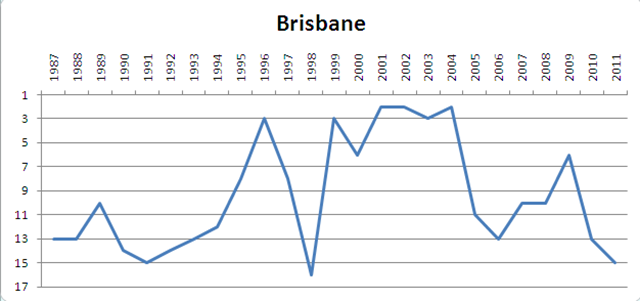
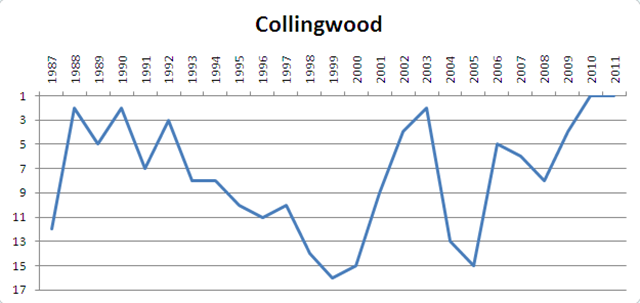
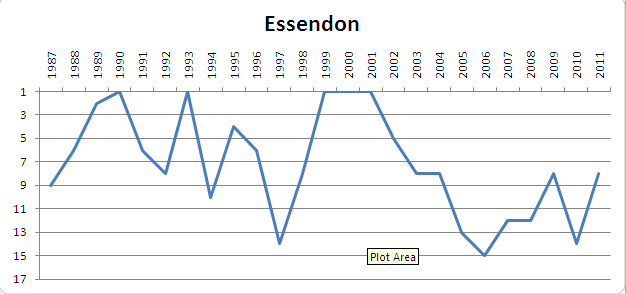
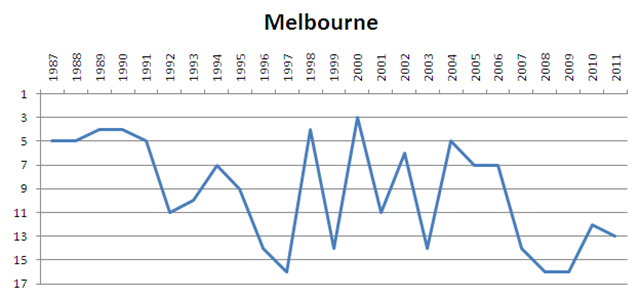
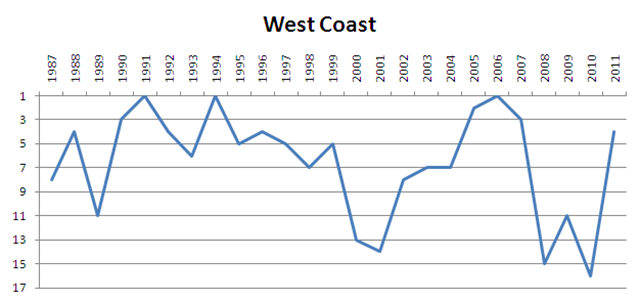
Toward the end of the 2011 home and away rounds, when there was the seemingly usual speculation about whether Richmond would finish ninth — again — we began thinking about looking at trends of teams’ home and away rounds finishing positions. The following charts covering the past quarter century are presented as much for information and casual glancing as for any hard-nosed analysis. We’ve refrained from making bleeding obvious comments, except for the afore-mentioned Tigers.


Comments and thoughtful analysis are encouraged.

afl - adelaide chart

afl - brisbane chart

afl - carlton chart

afl - collingwood chart

afl - essendon chart

Fitzroy

afl - fitzroy-brisbane chart

afl - fremantle chart

afl - geelong chart

afl - hawthorn chart

afl - melbourne chart

afl - nthmelbourne chart

afl - ptadelaide chart

afl - richmond chart

Having experienced a rampant Richmond in the late 60s and through the 70s, it’s quite difficult to feel anything resembling sympathy for those hordes of Tigers fans, yet AussieRulesBlog is moved to compassion by this chart of almost unremitting mediocrity. Interestingly, the Tiges have finished ninth on only six occasions in the last quarter century, somewhat destroying that fondly-held myth of their almost perpetual ninth-ness.

afl - stkilda chart

afl - sydney chart

afl - wce chart

afl - wbulldogs chart

Read More

Wednesday, October 05, 2011

Clubs get smarter with debutante coaches

No comments:

Have we seen the last of debutante coaches struggling to come to grips with the myriad tasks they need to manage? These days, finding an experienced mentor/assistant goes right along with appointing a debutante coach.


Some readers may be old enough to recall the not-so-slow-motion train wrecks that were the emergence — and disappearance — as coaches of Tim Watson, Peter Rohde and Bernie Quinlan. Fair enough that the Rohde and Quinlan appointments had as much to do about money as capacity to coach, but they did fail spectacularly.


Two years ago, the Barcodes led the way by announcing a deal to have Malthouse move to a Director of Coaching role when Buckley took over. Never mind the tension between them, Eddie Maguire and fellow Board members knew their star needed a sounding board. With the increasing tension, moving Malthouse out and Eade in provides the experience as a foundation, just in case Buckley falls in a heap.


Last year at about this time, the Bombers engaged in their own changeover, engineering Bomber Thompson and a star-studded panel of assistants to ease James Hird into the role.


Now, Brenton Sanderson has Dean Bailey watching his back at Adelaide, while Mark Neeld will be able to lean on Neil Craig’s experience.


Brendan McCartney appears, at the time of writing, to be going without a “senior assistant” at the Western Bulldogs, while St Kilda are yet to announce a senior coach for 2012. It’s also worth noting that neither Brad nor Chris Scott have former senior coaches on their panels.


The ranks of suitably-experienced former head coaches are being thinned out, with only Malthouse and Mark Harvey among the recently dethroned who haven’t been snapped up by other clubs. Gary Ayers remains active, but may have been away from the top level for a little too long, while Matthew Knights appears friendless.


What does the employment of a “senior assistant”, especially one just turfed out of his own club, say to a new coach. Is it a positive story about fast-tracked development in the lead role, or is it an insurance policy?

Read More

Tuesday, October 04, 2011

Giesch spin raises question

4 comments:

AFL Umpiring boss Jeff Gieschen has been rolled out after the Grand Final to perform his verbal pirouettes again, this time over the goal/behind to the Barcodes’ Sharrod Wellingham. Once more, the spectre of video referrals of goal umpiring decisions has been raised, even though the 2010 pre-season trial of the process was, in AussieRulesBlog’s view, an unmitigated waste of time.


But the big issue we should be focussing on is buried at the end of Gieschen’s statement on the matter. Discussing the process the on-field umpires went through in coming to the decision, he says:


"Our field umpire (Shaun Ryan) actually asked the two boundary umpires, who were both on the posts, what they thought [and] they couldn't add anything.
"He then asked the other field umpires.
"It would have been probably nice if we had gone back to the goal umpire as well."


So, was the decision made by the field umpire or the goal umpire? Why would it have been nice to go back to the goal umpire? Did the field umpire signal All Clear with two hands, suggesting a goal? Did the goal umpire change his decision on that basis?


Regardless, AussieRulesBlog thinks there’s far too much emphasis on mistakes by goal umpires. The error rate is minute. Both Chris Dawes and Tom Hawkins had gimme opportunities to score goals — and missed. Why aren’t we focussing on those incidents?


And if Gieschen is so damned worried about getting it as right as it can possibly be, what about looking at a consistent interpretation and application of the laws of the game from the first bounce of pre-season to the final siren of the Grand Final? Now THAT would be a step forward!


Release the Giesch!!!!!

Read More

Sunday, October 02, 2011

Annual Grand Final review

No comments:

From feeling quite nervous about the Barcodes winning at three-quarter time, AussieRulesBlog’s demeanour improved markedly as the final quarter unfolded. The Cats had, in our view, looked far more dangerous all day, while the Barcodes had made the most of their opportunities to keep themselves very much in the game right through to mid way through the final quarter.


When the game broke, it broke in a big way and the result didn’t truly reflect the intensity of the competition for the ball.


It was certainly far more pleasant walking away from the G after a Pussy Power triumph than it would have been with a Barcodes victory. We’ve suffered plenty of defeats at the hands of the Barcodes and their fans can be in your face and obnoxious in their gloating. It was a very civil end to the day yesterday.


The day was made far more interesting for AussieRulesBlog in anticipating, and then marvelling at, the pre-game.


Arriving at our seats, we couldn’t fail to notice a rather large facsimile Premiership Cup standing on the centre circle, standing perhaps eight metres tall.


As the time for football approached, ten or so black-clad ‘roadies’ appeared through a gate in the boundary fence. Each was carrying a white box. Ikea was our first thought, quickly followed by Lego.


The roadies installed these boxes in a line just inside the centre square and then retreated to the boundary again. Soon they reappeared and placed another five boxes, then proceeded to bring out yet more boxes and line these up on the other side of the centre square. A quick count suggested something to do with Premierships won.


What a good thing they hadn’t used this idea last year! Imagine the Barcodes fourteen boxes on one side and the Saints lonely single box on the other! But we digress.


Retiring players (and umpires) were paraded around the ground, followed by Rising Star, Dyson Heppell.


Craig Willis’ stentorian tones began announcing former Barcodes players and they began appearing from within the teeming mass that is the Barcodes cheer squad, carrying a Premiership Cup each. They walked in a rag-tag fashion, toward the line of boxes — now revealed to be plinths — and placed the cups atop the plinths.


Next the same happened with the Geelong Premierships from the Cats’ cheer squad end, except that the former Cats made the Barcodes greats look like a precision drill team, such was the disorganised nature of their progress toward their plinths. Organisation? Planning? Rehearsal? Telling participants what they’re expected to do and when? These are foreign concepts to those charged with AFL Grand Final ‘Spectaculars’.


In the end, one of the Geelong Cups appeared from the direction of the interchange benches and former Geelong captain, Stephen King — carrying the obligatory child: We’re coming around to Brian Taylor’s thinking on this — had to sprint from the parade of retirees to the parade of former champions carrying Premiership Cups. Organisation? Did no-one think to wonder how King would participate in these two ‘entertainments’?


Next, a roar of Harley Davidsons — have we just coined a new collective noun? — was heard and then seen on the big screen riding up a ramp and out onto the boundary verge. Not surprisingly, this signalled the beginning of Mr Loaf’s contribution to proceedings. Also not surprisingly, the Harleys fitted nicely with Mr Loaf’s rendition of Hot Patootie, famously sung in The Rocky Horror Picture Show by Mr Loaf astride a Harley!


We here at AussieRulesBlog Central are partial to a bit of Mr Loaf. He’s not on high rotation, but a bit of Bat Out of Hell or Paradise by the Dashboard Light can gladden our hearts occasionally, so we were quite looking forward to this performance.


It’s worth mentioning here that we attended five MCG finals this year, being lucky enough to have access to a series ticket and buying a ticket to see the Bombers in week one. For the previous finals, musical acts had provided pre-game and half-time entertainment. From where we were sitting, beneath the scoreboard in the Ponsford Stand, the bands were extremely loud but the sound quality was otherwise quite acceptable.


Having mentioned that, no-one will be surprised to learn that the sound for Mr Loaf, at least where AussieRulesBlog was sitting, would still have been abysmal if it had been improved by 400%. For some reason known only to the organisers, they had foresworn the perfectly good, albeit extraordinarily loud, MCG sound system and instead wheeled out speakers on little trolleys that were last used in the days before the redevelopment of the northern side of the stadium. What emerged from these toy speakers was undoubtedly a cacophony, but little of it was recognisable as Mr Loaf’s work.


Whilst Mr Loaf had been purveying his wares, one of the event staff came out onto the field and gave directions, individually, to the former Barcodes players still standing dutifully by their Premiership Cups. We were somewhat stunned to realise that said event person was repeating the same instructions to each former player — and some of them weren’t keen to buy! Organisation? Planning? Rehearsal?


Eventually, by the end of Mr Loaf’s set, the former players had retired to parts unknown and the Premiership Cups stood resplendent on their plinths, alone and unassisted (bar a sandbag each to keep them in place).


We had been curious that two drum kits on wheeled trolleys had been rolled out during the aforementioned Meat Loaf performance. They weren’t involved in the performance, but just sat there. Also during Meat Loaf’s gig, two groups of scarf-wearing people were escorted onto the arena, one to each end. Once Meat Loaf had finished, the wheeled drum kits were pushed to the top of the goal square at each end and sundry musicians appeared and plugged in their guitars. The two groups of people turned out to be two “choirs” whose task it was to belt out the respective club songs. They seemed not to be plugged into either the MCG sound system, nor Meat Loaf’s, because the Geelong choir’s rendition of the Toreador Song, at the other end of the ground, was very muted.


As the choirs sang, two helium balloons in the (rough) shape of a Sherrin football were elevated to about twenty metres and a banner for each club was unfurled as their song was performed. It was breathtakingly innovative and spectacular — NOT!


Now the former players of both clubs returned to their respective Cups, and retrieved them to two lines forming a ‘Guard of Honour’ before yet another plinth on which the actual Premiership Cup for 2011 would sit. We can’t say it was a total surprise, but we were nevertheless gobsmacked to see a door open in the base of the large Premiership Cup facsimile and a gent emerge carrying the real thing. The Cup was presented to Doug Wade and Murray Wiederman who would present the Cup in the event that either Geelong or Collingwood, respectively, won the game.


And then there were the Ross Oakley memorial fireworks, after which is was all but impossible to see the crowd on the other side of the ground.


Was the fun over? No on your life. The Premiership Cup facsimile which had stood at centre field was transported to the boundary where a team of construction workers disassembled it using tools including a scissor lift and a forklift — a process that seemed to occupy ten minutes of none-too-frantic activity.


Soon after, to everyone’s relief, a game of footy broke out and two hours was spent savouring a wonderful game.


At the conclusion of the game, the MCC, in it’s infinite wisdom, rolled out one of its officious besuited types leading half a dozen MCC staff along with two contraptions for dispensing rope. These people proceeded, Keystone Cops-like, to construct  a rope barrier in front of the dais where the Premiership Medal and Cup were to be presented. Clearly the requirements of the task had not been discussed previously (or the staff were all cloth-eared twits, which is not completely impossible!), because the ensuing action was worthy of a slapstick comedy award. Quite why these worthies were erecting a barrier when unauthorised entry to the playing arena carries a $7,000 fine quite escapes us. And the ‘barrier’ would stop who or what? It’s a rope for goodness sakes.


And so ended our big day. The game had lived up to the billing. The result was the one we preferred. The atmosphere was civil at the end of the game. The pre-game entertainment was an amateurish shambles. Our Grand Final  experience was complete.

Read More

Friday, September 30, 2011

GF ticket complaints are disingenuous

No comments:

Barcodes CEO Gary Pert is reported to be upset that high-priced Grand Final packages limit the opportunities for Barcodes’ members to attend the big dance. (Yawn)


But 9,000 of the Barcodes’ 12,500 seat allocation are reserved for “Legends” members who are guaranteed a Grand Final ticket. Pert is also happily flogging Grand Final packages that include a ticket for $1500. So much for concern for members!


The Cats and the Docklands stadium management are doing their bit too, selling packages that include a ticket for $1450, while the AFLPA is doling out packages for a princely $1800.


Let’s get real about all of this — apart from the AFLPA for the moment. Despite the windfall allocations to clubs next year from the new broadcast agreement, running any AFL club, let alone one competing at the pointy end, is a very expensive proposition. Money has to come from somewhere and part of that somewhere is flogging these Grand Final packages to those happy to fork out the bigger bucks.


We could go back to the 60s when tickets were considerably less expensive (even allowing for inflation) and less desirable for the ‘social’ attendees, but players wouldn’t be full-time professionals. there’d be no full-time coaches and the game would be a pale shadow of what we see today.


Let’s all just get over it. The ticketing for this Grand Final was never going to be any better than last year, or the year before that. So why are we having this debate yet again?


Now, back to the AFLPA. They’re selling Grand Final packages for $1800? Is this a ticket allocation from the AFL? Or are AFLPA members donating their club-supplied tickets to their association? One supposes that Matt Finnis and Ian Prendergast and co get paid some sort of salary or stipend, but perhaps the members could cover that?

Read More

Thursday, September 29, 2011

A place for fairest

4 comments:

That perennial discussion has erupted again, this time apparently because Sam Mitchell nearly ‘won’ the Brownlow Medal but would have been ineligible to take the prize having pled guilty to an MRP charge.


It seems to be forgotten — every year — but the Brownlow is awarded to the fairest and best player as judged by the field umpires. There’s a reason that the Brownlow is held in such high esteem.


Players who flagrantly transgress the laws of the game can win any one of almost countless media awards. There’s a reason that those media awards aren’t seen as equivalent to the Brownlow.


It’s one word — fairest. This award is about the game being played in the finest spirit of sportsmanship and what a fine ideal that is to emphasise.


The guys to whom we entrust the control of each game, and whom we trust to exercise that control disinterestedly, are the closest to the game and they see a lot more than media pundits do, and often a lot more than television, for all its technical wizardry, does.


The umpires don’t have access to statistics when casting their votes — a scandal according to some. Surely we have enough recognition of players based on their statistical output already? Media award voting seems to be, generally, stats-based assessment. Eight goals will get Lance Franklin three votes, but eight perfect kicks to teammates won’t get the centre half-back more than a pass mark.


The latest calls for change would have minor misdemeanors discounted to maintain Brownlow eligibility. Why? Did Sam Mitchell do something that contravened the laws of the game? Yes, he did. His guilty plea says he admits guilt. If he hadn’t dome anything wrong, he wouldn’t have been charged. And, if you asked him, he’d surely answer that team success means far more to him than individual honours.


Let’s say it again: the Brownlow recognises the player who plays the game according to the highest traditions of sportsmanship and is the best player according to that criterion.


Change? Why? What is it that is broken about the current system?

Read More

Process, not technology, the answer to scoring misses

Another Grand Final scoring blunder and the football community has to, yet again, endure the nonsense proposition that technology must be used to assist umpires in scoring decisions.


Let’s start by getting the situation straight on the Wellingham “goal”. This was not a goal umpiring error per se. It was an error of process in that the goal umpire was too influenced by a field umpire.


The goal umpire was in the correct position to make a decision. The field umpire was not. We see, week in and week out, goal umpires relying on boundary umpires to assist with set shot scoring decisions. The goal umpire looks to the boundary umpire who signals whether the ball passed inside or outside the behind post. This works because the boundary umpire is standing right at the behind post.


And yet, the AFL umpiring department has field umpires — not standing at the posts and not at the goal line — directing goal umpires. Incredible.


Two years ago, the Tom Hawkins “goal” was a different matter. Hawkins’ snapshot didn’t allow any time for boundary umpires to be in position at the behind posts. The goal umpire was attempting to make ground to get into position to see the ball and, understandably, did not see the deflection from the goal post. Had the broadcaster not had a camera trained at the incident from the angle they did, it’s quite possible that only a few fans at the game would have been aware that the ball had hit the post.


In both instances then, detecting an error relied very heavily on there being a camera with a view from an appropriate angle. So, what technology are we going to employ? Instant replay from the broadcaster. And with every angle covered? Of course not.


And if that replay is inconclusive? Current practice is that the lesser score option is awarded. Is that more right than the current decision-making process?


There are three simple points to a solution to this “problem”.

  1. Goal umpire’s decisions are the prime scoring decision unless some other umpire is 100% certain that the decision is incorrect.
  2. Employ four goal umpires per game.
  3. Australian rules football has uncertainties built in — the shape of the ball not the least of them. There is no absolutely certain process for making these decisions, so let’s accept that the current error rate of something less than one tenth of one percent is a pretty damned good result.

There is some justification for goal line cameras, but even these offer less than conclusive evidence given the speed of the ball and the often slight touches players may get on the ball.


As we’ve noted on many occasions, the negatives of video decision-assist outweigh any positives to an extraordinary degree.

  • In the event of a “behind” decision, the defending team loses the advantage of a quick kick out while a video review is conducted.
  • The game’s rhythm is upset by the break for video review.
  • Video review doesn’t guarantee certainty.

No advantage in this decision

AFL football operations boss Adrian Anderson has announced only minor changes to the open sore that was player-initiated advantage.


Anderson said the slight modification was made after feedback from clubs, players and fans. Well, that may be strictly true, but AussieRulesBlog finds it difficult to imagine that any of the mentioned groups would have agreed to the rule remaining in any form.


Advantage will not apply in 2012 to free kicks paid by an “out-of-zone” umpire. Superficially, this seems like an improvement, but there are plenty of scenarios in games, especially at stoppages at either end of the ground, where two umpires operate in quite close proximity.


The umpires seem to have a fairly good handle on which of them is in control at any point, but for the rest of us it is a mystery.


Most puzzlingly, in 2012 the umpires will have “more time allowed … to consider the actual advantage.”


What? If there’s no advantage, they’ll call the ball back? Certainly, there were any number of incidents during 2011 where this seemed to happen, despite the provision for such action having been removed in the rewriting of the advantage law to allow player-initiated advantage.


The game now finds itself in a position where the lawmakers don’t rewrite a law that doesn’t work. Instead, changes to interpretations — for the most part not codified — are announced, and then the interpretation of the interpretation changes evolve over time as the laws committee and the umpiring administration realise that their initial interpretations are overzealous.


This continual tinkering, especially when it’s not spelled out clearly in a written law, is a crock.


Player-initiated advantage was, and is, a nonsense in Australian rules. It doesn’t work. Players are confused. Umpires are confused. Media are confused. Fans are confused. These changes don’t turn a sow’s ear into a silk purse. It’s still a sow’s ear, no matter how hard the AFL talks it up.

Success is cyclical — for most

Toward the end of the 2011 home and away rounds, when there was the seemingly usual speculation about whether Richmond would finish ninth — again — we began thinking about looking at trends of teams’ home and away rounds finishing positions. The following charts covering the past quarter century are presented as much for information and casual glancing as for any hard-nosed analysis. We’ve refrained from making bleeding obvious comments, except for the afore-mentioned Tigers.


Comments and thoughtful analysis are encouraged.

afl - adelaide chart

afl - brisbane chart

afl - carlton chart

afl - collingwood chart

afl - essendon chart

Fitzroy

afl - fitzroy-brisbane chart

afl - fremantle chart

afl - geelong chart

afl - hawthorn chart

afl - melbourne chart

afl - nthmelbourne chart

afl - ptadelaide chart

afl - richmond chart

Having experienced a rampant Richmond in the late 60s and through the 70s, it’s quite difficult to feel anything resembling sympathy for those hordes of Tigers fans, yet AussieRulesBlog is moved to compassion by this chart of almost unremitting mediocrity. Interestingly, the Tiges have finished ninth on only six occasions in the last quarter century, somewhat destroying that fondly-held myth of their almost perpetual ninth-ness.

afl - stkilda chart

afl - sydney chart

afl - wce chart

afl - wbulldogs chart

Clubs get smarter with debutante coaches

Have we seen the last of debutante coaches struggling to come to grips with the myriad tasks they need to manage? These days, finding an experienced mentor/assistant goes right along with appointing a debutante coach.


Some readers may be old enough to recall the not-so-slow-motion train wrecks that were the emergence — and disappearance — as coaches of Tim Watson, Peter Rohde and Bernie Quinlan. Fair enough that the Rohde and Quinlan appointments had as much to do about money as capacity to coach, but they did fail spectacularly.


Two years ago, the Barcodes led the way by announcing a deal to have Malthouse move to a Director of Coaching role when Buckley took over. Never mind the tension between them, Eddie Maguire and fellow Board members knew their star needed a sounding board. With the increasing tension, moving Malthouse out and Eade in provides the experience as a foundation, just in case Buckley falls in a heap.


Last year at about this time, the Bombers engaged in their own changeover, engineering Bomber Thompson and a star-studded panel of assistants to ease James Hird into the role.


Now, Brenton Sanderson has Dean Bailey watching his back at Adelaide, while Mark Neeld will be able to lean on Neil Craig’s experience.


Brendan McCartney appears, at the time of writing, to be going without a “senior assistant” at the Western Bulldogs, while St Kilda are yet to announce a senior coach for 2012. It’s also worth noting that neither Brad nor Chris Scott have former senior coaches on their panels.


The ranks of suitably-experienced former head coaches are being thinned out, with only Malthouse and Mark Harvey among the recently dethroned who haven’t been snapped up by other clubs. Gary Ayers remains active, but may have been away from the top level for a little too long, while Matthew Knights appears friendless.


What does the employment of a “senior assistant”, especially one just turfed out of his own club, say to a new coach. Is it a positive story about fast-tracked development in the lead role, or is it an insurance policy?

Giesch spin raises question

AFL Umpiring boss Jeff Gieschen has been rolled out after the Grand Final to perform his verbal pirouettes again, this time over the goal/behind to the Barcodes’ Sharrod Wellingham. Once more, the spectre of video referrals of goal umpiring decisions has been raised, even though the 2010 pre-season trial of the process was, in AussieRulesBlog’s view, an unmitigated waste of time.


But the big issue we should be focussing on is buried at the end of Gieschen’s statement on the matter. Discussing the process the on-field umpires went through in coming to the decision, he says:


"Our field umpire (Shaun Ryan) actually asked the two boundary umpires, who were both on the posts, what they thought [and] they couldn't add anything.
"He then asked the other field umpires.
"It would have been probably nice if we had gone back to the goal umpire as well."


So, was the decision made by the field umpire or the goal umpire? Why would it have been nice to go back to the goal umpire? Did the field umpire signal All Clear with two hands, suggesting a goal? Did the goal umpire change his decision on that basis?


Regardless, AussieRulesBlog thinks there’s far too much emphasis on mistakes by goal umpires. The error rate is minute. Both Chris Dawes and Tom Hawkins had gimme opportunities to score goals — and missed. Why aren’t we focussing on those incidents?


And if Gieschen is so damned worried about getting it as right as it can possibly be, what about looking at a consistent interpretation and application of the laws of the game from the first bounce of pre-season to the final siren of the Grand Final? Now THAT would be a step forward!


Release the Giesch!!!!!

Annual Grand Final review

From feeling quite nervous about the Barcodes winning at three-quarter time, AussieRulesBlog’s demeanour improved markedly as the final quarter unfolded. The Cats had, in our view, looked far more dangerous all day, while the Barcodes had made the most of their opportunities to keep themselves very much in the game right through to mid way through the final quarter.


When the game broke, it broke in a big way and the result didn’t truly reflect the intensity of the competition for the ball.


It was certainly far more pleasant walking away from the G after a Pussy Power triumph than it would have been with a Barcodes victory. We’ve suffered plenty of defeats at the hands of the Barcodes and their fans can be in your face and obnoxious in their gloating. It was a very civil end to the day yesterday.


The day was made far more interesting for AussieRulesBlog in anticipating, and then marvelling at, the pre-game.


Arriving at our seats, we couldn’t fail to notice a rather large facsimile Premiership Cup standing on the centre circle, standing perhaps eight metres tall.


As the time for football approached, ten or so black-clad ‘roadies’ appeared through a gate in the boundary fence. Each was carrying a white box. Ikea was our first thought, quickly followed by Lego.


The roadies installed these boxes in a line just inside the centre square and then retreated to the boundary again. Soon they reappeared and placed another five boxes, then proceeded to bring out yet more boxes and line these up on the other side of the centre square. A quick count suggested something to do with Premierships won.


What a good thing they hadn’t used this idea last year! Imagine the Barcodes fourteen boxes on one side and the Saints lonely single box on the other! But we digress.


Retiring players (and umpires) were paraded around the ground, followed by Rising Star, Dyson Heppell.


Craig Willis’ stentorian tones began announcing former Barcodes players and they began appearing from within the teeming mass that is the Barcodes cheer squad, carrying a Premiership Cup each. They walked in a rag-tag fashion, toward the line of boxes — now revealed to be plinths — and placed the cups atop the plinths.


Next the same happened with the Geelong Premierships from the Cats’ cheer squad end, except that the former Cats made the Barcodes greats look like a precision drill team, such was the disorganised nature of their progress toward their plinths. Organisation? Planning? Rehearsal? Telling participants what they’re expected to do and when? These are foreign concepts to those charged with AFL Grand Final ‘Spectaculars’.


In the end, one of the Geelong Cups appeared from the direction of the interchange benches and former Geelong captain, Stephen King — carrying the obligatory child: We’re coming around to Brian Taylor’s thinking on this — had to sprint from the parade of retirees to the parade of former champions carrying Premiership Cups. Organisation? Did no-one think to wonder how King would participate in these two ‘entertainments’?


Next, a roar of Harley Davidsons — have we just coined a new collective noun? — was heard and then seen on the big screen riding up a ramp and out onto the boundary verge. Not surprisingly, this signalled the beginning of Mr Loaf’s contribution to proceedings. Also not surprisingly, the Harleys fitted nicely with Mr Loaf’s rendition of Hot Patootie, famously sung in The Rocky Horror Picture Show by Mr Loaf astride a Harley!


We here at AussieRulesBlog Central are partial to a bit of Mr Loaf. He’s not on high rotation, but a bit of Bat Out of Hell or Paradise by the Dashboard Light can gladden our hearts occasionally, so we were quite looking forward to this performance.


It’s worth mentioning here that we attended five MCG finals this year, being lucky enough to have access to a series ticket and buying a ticket to see the Bombers in week one. For the previous finals, musical acts had provided pre-game and half-time entertainment. From where we were sitting, beneath the scoreboard in the Ponsford Stand, the bands were extremely loud but the sound quality was otherwise quite acceptable.


Having mentioned that, no-one will be surprised to learn that the sound for Mr Loaf, at least where AussieRulesBlog was sitting, would still have been abysmal if it had been improved by 400%. For some reason known only to the organisers, they had foresworn the perfectly good, albeit extraordinarily loud, MCG sound system and instead wheeled out speakers on little trolleys that were last used in the days before the redevelopment of the northern side of the stadium. What emerged from these toy speakers was undoubtedly a cacophony, but little of it was recognisable as Mr Loaf’s work.


Whilst Mr Loaf had been purveying his wares, one of the event staff came out onto the field and gave directions, individually, to the former Barcodes players still standing dutifully by their Premiership Cups. We were somewhat stunned to realise that said event person was repeating the same instructions to each former player — and some of them weren’t keen to buy! Organisation? Planning? Rehearsal?


Eventually, by the end of Mr Loaf’s set, the former players had retired to parts unknown and the Premiership Cups stood resplendent on their plinths, alone and unassisted (bar a sandbag each to keep them in place).


We had been curious that two drum kits on wheeled trolleys had been rolled out during the aforementioned Meat Loaf performance. They weren’t involved in the performance, but just sat there. Also during Meat Loaf’s gig, two groups of scarf-wearing people were escorted onto the arena, one to each end. Once Meat Loaf had finished, the wheeled drum kits were pushed to the top of the goal square at each end and sundry musicians appeared and plugged in their guitars. The two groups of people turned out to be two “choirs” whose task it was to belt out the respective club songs. They seemed not to be plugged into either the MCG sound system, nor Meat Loaf’s, because the Geelong choir’s rendition of the Toreador Song, at the other end of the ground, was very muted.


As the choirs sang, two helium balloons in the (rough) shape of a Sherrin football were elevated to about twenty metres and a banner for each club was unfurled as their song was performed. It was breathtakingly innovative and spectacular — NOT!


Now the former players of both clubs returned to their respective Cups, and retrieved them to two lines forming a ‘Guard of Honour’ before yet another plinth on which the actual Premiership Cup for 2011 would sit. We can’t say it was a total surprise, but we were nevertheless gobsmacked to see a door open in the base of the large Premiership Cup facsimile and a gent emerge carrying the real thing. The Cup was presented to Doug Wade and Murray Wiederman who would present the Cup in the event that either Geelong or Collingwood, respectively, won the game.


And then there were the Ross Oakley memorial fireworks, after which is was all but impossible to see the crowd on the other side of the ground.


Was the fun over? No on your life. The Premiership Cup facsimile which had stood at centre field was transported to the boundary where a team of construction workers disassembled it using tools including a scissor lift and a forklift — a process that seemed to occupy ten minutes of none-too-frantic activity.


Soon after, to everyone’s relief, a game of footy broke out and two hours was spent savouring a wonderful game.


At the conclusion of the game, the MCC, in it’s infinite wisdom, rolled out one of its officious besuited types leading half a dozen MCC staff along with two contraptions for dispensing rope. These people proceeded, Keystone Cops-like, to construct  a rope barrier in front of the dais where the Premiership Medal and Cup were to be presented. Clearly the requirements of the task had not been discussed previously (or the staff were all cloth-eared twits, which is not completely impossible!), because the ensuing action was worthy of a slapstick comedy award. Quite why these worthies were erecting a barrier when unauthorised entry to the playing arena carries a $7,000 fine quite escapes us. And the ‘barrier’ would stop who or what? It’s a rope for goodness sakes.


And so ended our big day. The game had lived up to the billing. The result was the one we preferred. The atmosphere was civil at the end of the game. The pre-game entertainment was an amateurish shambles. Our Grand Final  experience was complete.

GF ticket complaints are disingenuous

Barcodes CEO Gary Pert is reported to be upset that high-priced Grand Final packages limit the opportunities for Barcodes’ members to attend the big dance. (Yawn)


But 9,000 of the Barcodes’ 12,500 seat allocation are reserved for “Legends” members who are guaranteed a Grand Final ticket. Pert is also happily flogging Grand Final packages that include a ticket for $1500. So much for concern for members!


The Cats and the Docklands stadium management are doing their bit too, selling packages that include a ticket for $1450, while the AFLPA is doling out packages for a princely $1800.


Let’s get real about all of this — apart from the AFLPA for the moment. Despite the windfall allocations to clubs next year from the new broadcast agreement, running any AFL club, let alone one competing at the pointy end, is a very expensive proposition. Money has to come from somewhere and part of that somewhere is flogging these Grand Final packages to those happy to fork out the bigger bucks.


We could go back to the 60s when tickets were considerably less expensive (even allowing for inflation) and less desirable for the ‘social’ attendees, but players wouldn’t be full-time professionals. there’d be no full-time coaches and the game would be a pale shadow of what we see today.


Let’s all just get over it. The ticketing for this Grand Final was never going to be any better than last year, or the year before that. So why are we having this debate yet again?


Now, back to the AFLPA. They’re selling Grand Final packages for $1800? Is this a ticket allocation from the AFL? Or are AFLPA members donating their club-supplied tickets to their association? One supposes that Matt Finnis and Ian Prendergast and co get paid some sort of salary or stipend, but perhaps the members could cover that?

A place for fairest

That perennial discussion has erupted again, this time apparently because Sam Mitchell nearly ‘won’ the Brownlow Medal but would have been ineligible to take the prize having pled guilty to an MRP charge.


It seems to be forgotten — every year — but the Brownlow is awarded to the fairest and best player as judged by the field umpires. There’s a reason that the Brownlow is held in such high esteem.


Players who flagrantly transgress the laws of the game can win any one of almost countless media awards. There’s a reason that those media awards aren’t seen as equivalent to the Brownlow.


It’s one word — fairest. This award is about the game being played in the finest spirit of sportsmanship and what a fine ideal that is to emphasise.


The guys to whom we entrust the control of each game, and whom we trust to exercise that control disinterestedly, are the closest to the game and they see a lot more than media pundits do, and often a lot more than television, for all its technical wizardry, does.


The umpires don’t have access to statistics when casting their votes — a scandal according to some. Surely we have enough recognition of players based on their statistical output already? Media award voting seems to be, generally, stats-based assessment. Eight goals will get Lance Franklin three votes, but eight perfect kicks to teammates won’t get the centre half-back more than a pass mark.


The latest calls for change would have minor misdemeanors discounted to maintain Brownlow eligibility. Why? Did Sam Mitchell do something that contravened the laws of the game? Yes, he did. His guilty plea says he admits guilt. If he hadn’t dome anything wrong, he wouldn’t have been charged. And, if you asked him, he’d surely answer that team success means far more to him than individual honours.


Let’s say it again: the Brownlow recognises the player who plays the game according to the highest traditions of sportsmanship and is the best player according to that criterion.


Change? Why? What is it that is broken about the current system?